Let The Fugue Begin, again

Let’s Recap…..

Mid 2013: We entered the Program, sold our house, grabbed our chickens,  dug up our plants fled to the safest and most inconspicuous area to easily blend in- Tarzana, the San Fernando Valley, into the cabaña hovel at  The Compound also known as Gma’s/ Mom’s / Geri’s /or the Mother in law’s house.

Mid 2016  Felt the heat of the Valley, time for a change, packed up and sold The Compound, dropped Gma off in Santa Rosa, grabbed the dog, gave away the chickens (and most everything else!), re-dug up the plants, headed north to rainy Eugene, Oregon.

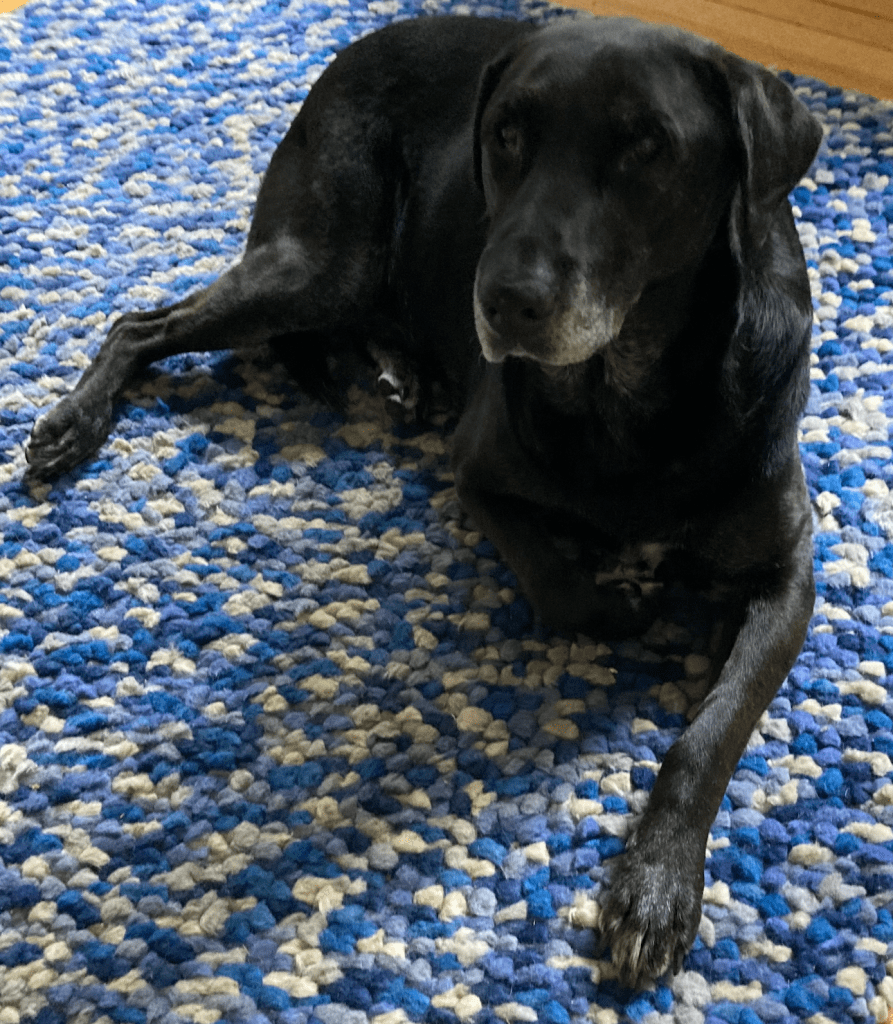
Mid 2017  All the plants planted and thriving, and nothing to do. So when the dog passed, we buried her with the plants, and began an international disappearance/fugue to Europe

Late 2019 Stumbled back to the US, laid low with the Gma again, this time in another inconspicuous place- senior living in Santa Rosa. https://thechosenfugue.blogspot.com/2019/10/living-lodge.html We celebrated her 90th, and then sadly Gma passed in early 2020.

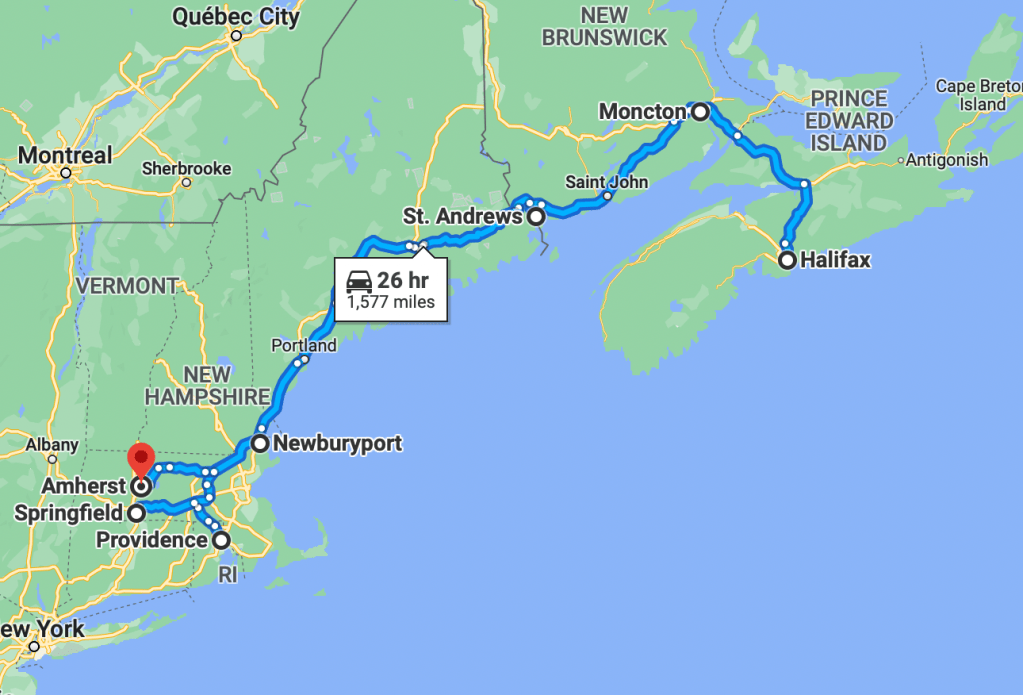
Summer 2020 Back in Eugene but feeling the heat and the need to keep moving. https://thechosenfugue.blogspot.com/2020/08/driving-to-end-of-rainbow.html We hurried cross country dodging Covid through some recklessly governed states to Amherst, MA, finding refuge in our underground hovel for 10 months and joy with our grand-daughter, her parents, her cats (Pip and Posy) and dog (Finn) https://thechosenfugue.blogspot.com/2020/08/our-year-of-living-dangerously-continues.html

Mid 2021  Needing to re-group, headed back west, stopped in the Twin Cities to find joy with our new grand-dog, Monty ( and his parent), and do some house-work on their new home. 

Summer 2021: Six weeks in Minneapolis, then a U-turn back to Amherst so Monty (and parent) could spend time with Finn and we all could help grand-daughter (niece) and her parents (sister/brother-in law) move into THEIR new house.  

After the move in, a quick cross-country back to Eugene as we raced through Covid hot spots again, unfortunately.

Now: The Witness Protection Program has told us we need to relocate, again, and they recommend as participants, maybe better not to blog our experiences, but we have decided instead to make ourselves a moving target (and changed the blog location, hence the weird change in styles).

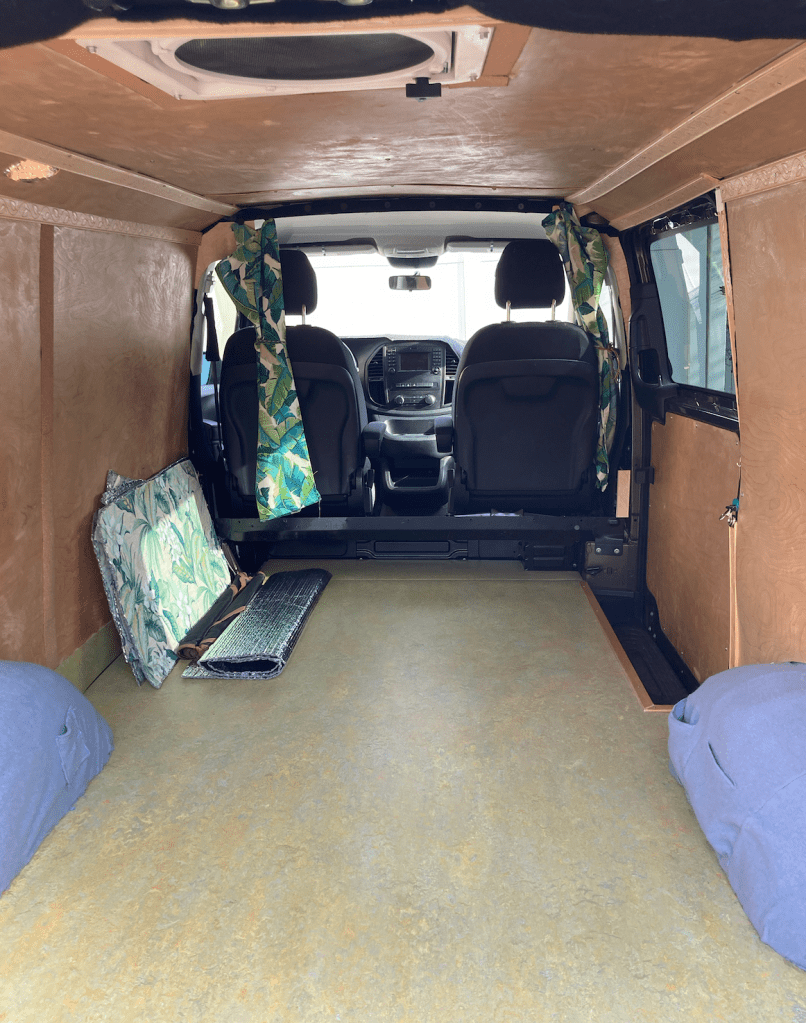
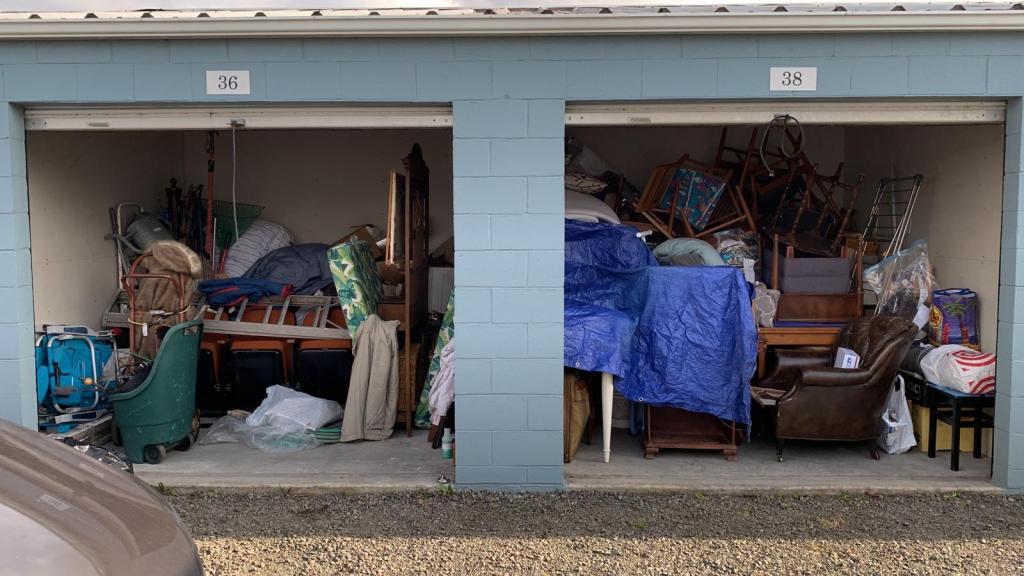
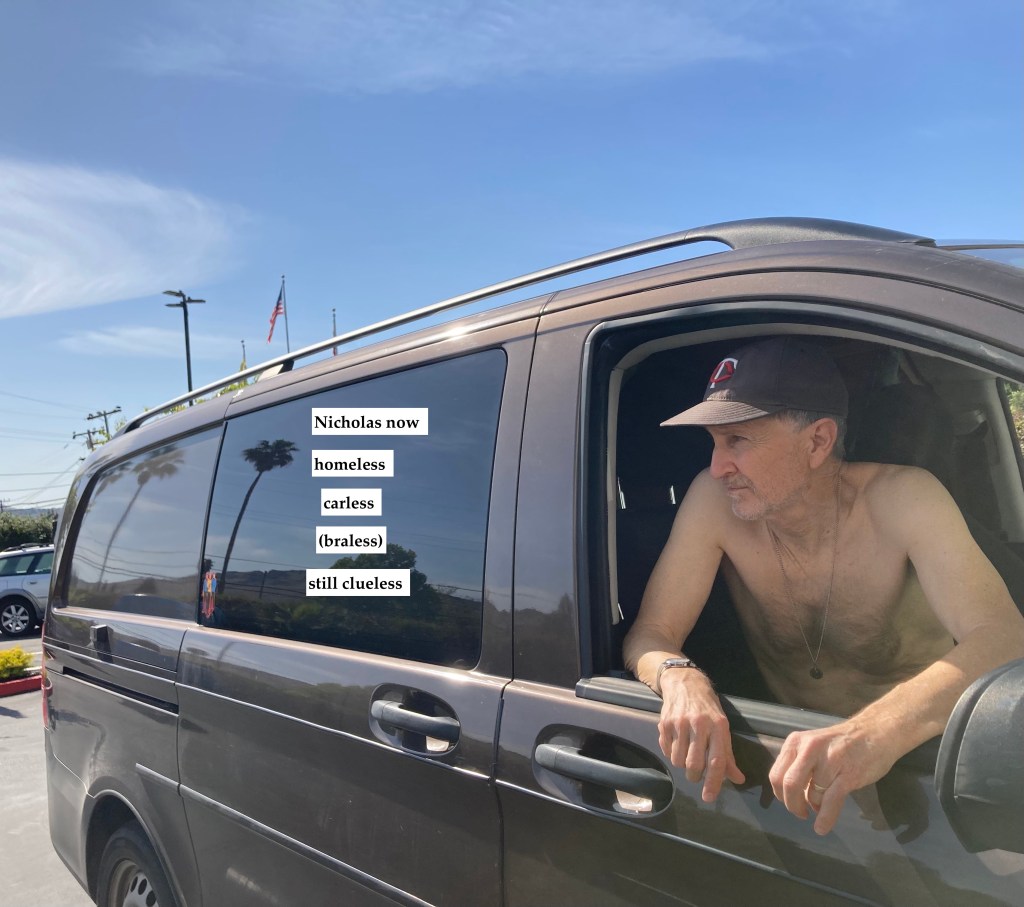
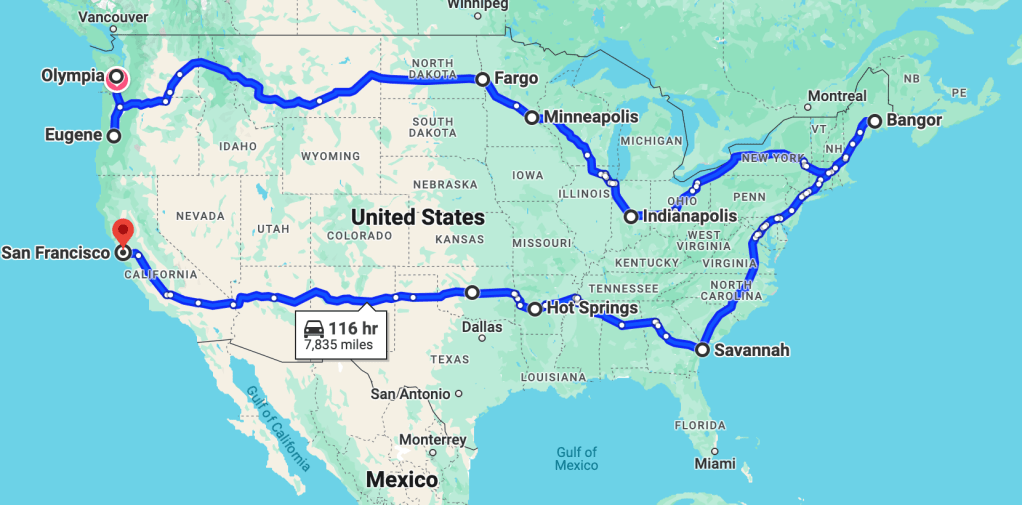
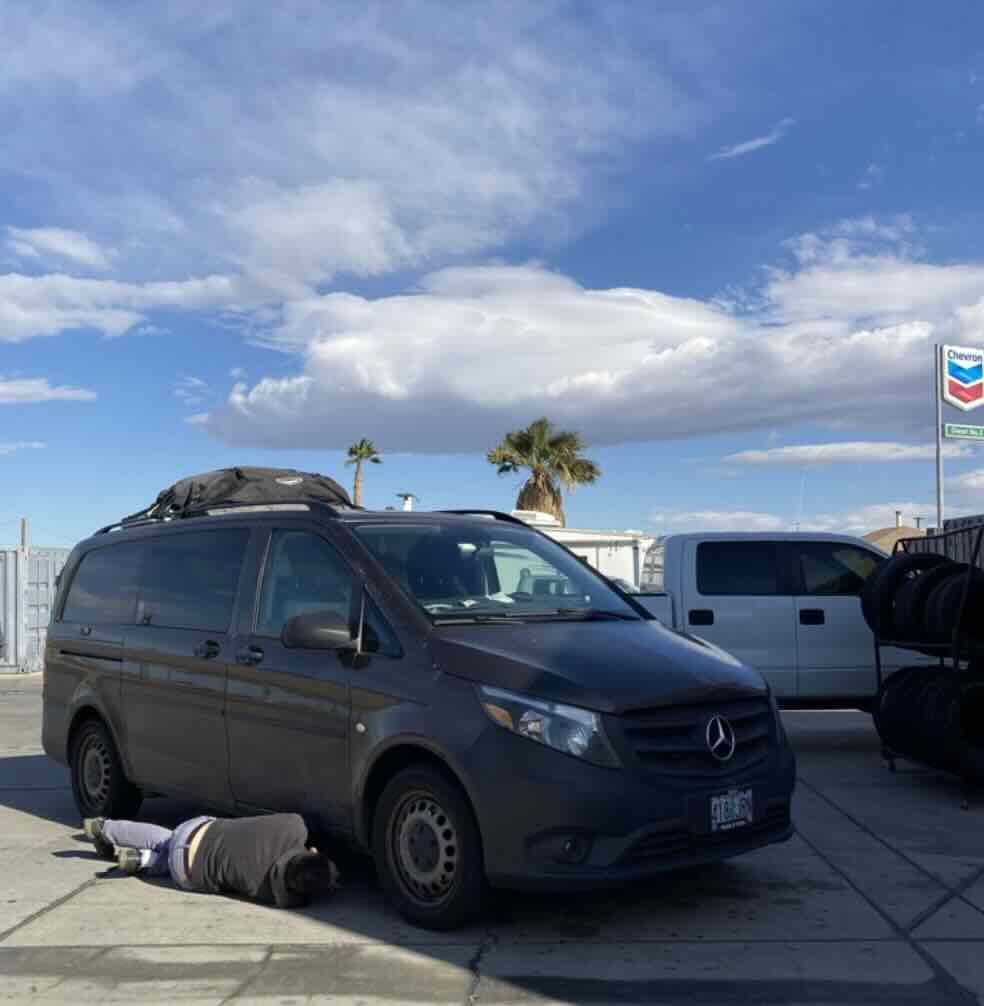
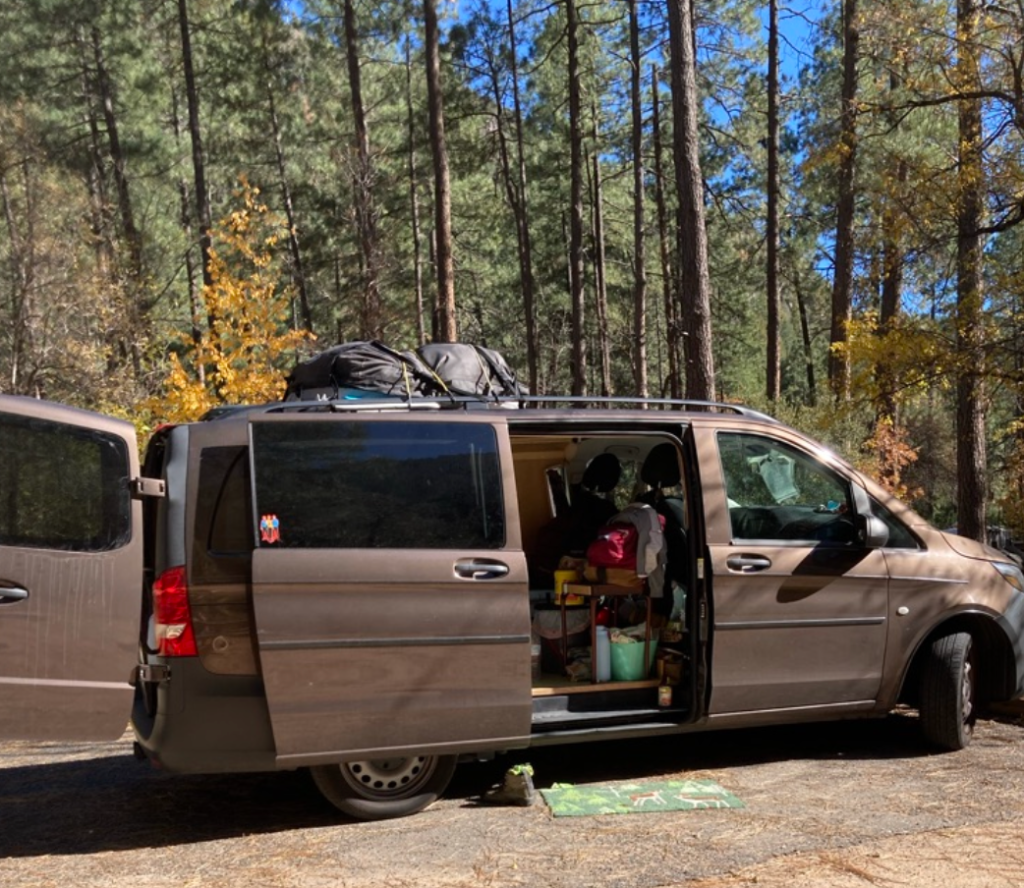
So, back on repeat- quickly sold the house, made 14 trips to Goodwill/Restore/St. Vincent’s, bought and converted a van (good for living and surveillance, if necessary), rented an address (aka tiny apartment in Olympia, WA) and hit the road, fugue on wheels.

States of never mind

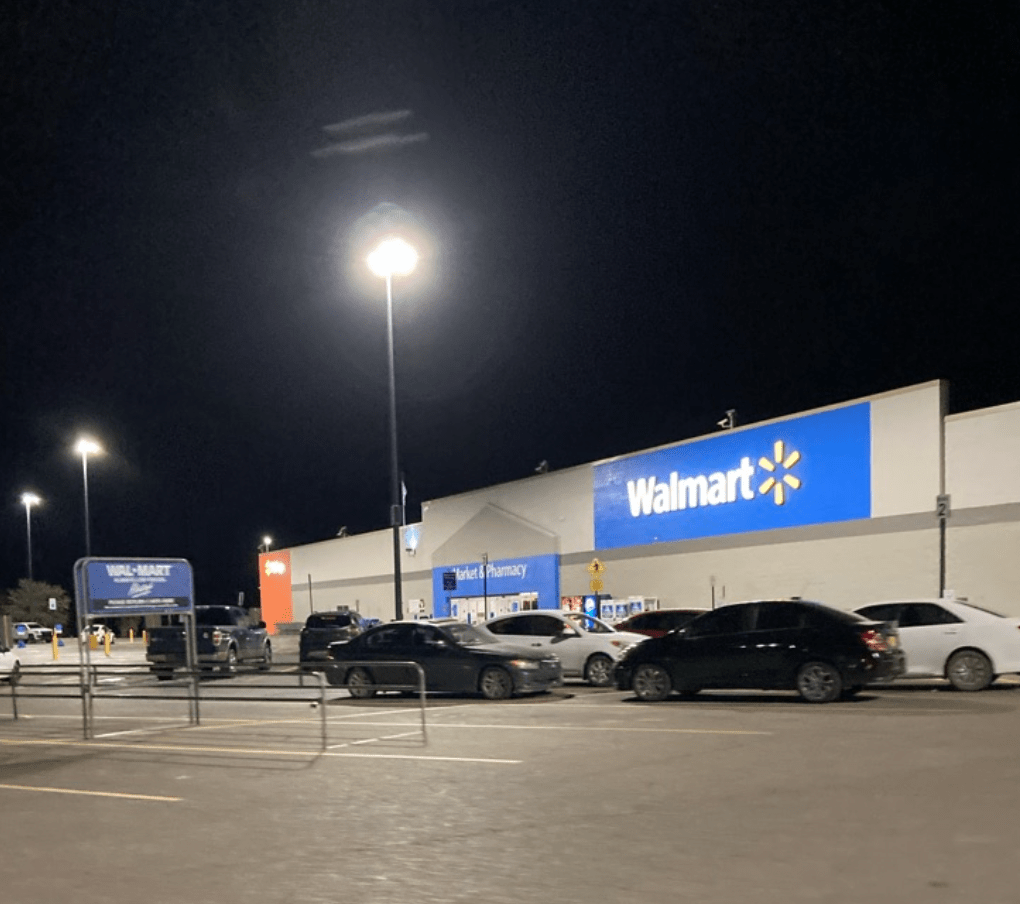
One of my sisters once told me, that on her deathbed, our grandmother told her one of the things she wished she had done in life was “go camping. It sounded like it would be so much fun.” Well Grandma Essie, it could be, but there is a lot of forced inconvenience which we have voluntarily welcomed (well, maybe not Patricia).  And, as a woman who owned furs, lived in a thoughtfully decorated San Francisco apartment and had a pet monkey, it may not be for everyone. But even as the weather has been turning colder, a lot of people are out camping, campground reservations are often hard to get and we are not alone at the Walmart parking lots.

We left Cline’s Corner truck stop in NM, traversing the very foggy edge of eastern NM. We would have been happy to bypass Texas but that is just not geographically possible. Santiago has a huge tank and for his size gets fairly decent mileage (23-27 mpg) so we figured we could get through without stopping. So we held our breath, and entered the state. We were so intent on getting through Texas, we didn’t bother to stop when we realized we were passing the Cadillac Ranch https://en.wikipedia.org/wiki/Cadillac_Ranch.  It is easily visible from highway 40 (encompasses old Route 66 through Amarillo). Cadillac Ranch looked kind of run down and trashed, analogous to the patron of the project who later was identified as being pretty trashy so that eased the guilt of the viewing at 75 mph. https://en.wikipedia.org/wiki/Stanley_Marsh_3

We made it through the Texas Panhandle only stopping once to use the bathroom which perhaps was an appropriate stop in Texas. We had planned to blast through Oklahoma as well, but we had to sleep.  A  highly recommended camp site was in a park run by the city of Sayre, OK. And it was OK. Clean bathroom, clean showers, water, electric hook up and even Bob’s Big Boy (welcome home!).


We laughed at campsites reviews about the “goatherds” like who would complain about goats, until we realized that goatherds are thorny seeds that stick to everything and really hurt. Yep, still rookies. It was so cold and rainy, Nick had to climb up to the “attic” to get the winter clothes, no furs. It was a shame about the weather as the park looked fun with a swimming pool and mini golf. But we left no more footprints in OK and made it to Arkansas the next afternoon. Our only planned stop in AR had been the Hot Springs National Forest, but after a tip from our daughter Simona, we diverted to Northwest AR for the Crystal Bridges Museum.  It opened just 10 years ago, and is now considered one of the best American museums.  It was started by a Walmart heir Alice Walton.  Unfortunately, we couldn’t spend the night in the parking lot, so we opted by a nearby state forest campground but since Winter is Coming, bathrooms and showers had been shut down for the season, but the very helpful park ranger said he had opened the ones at the neighboring campground. After Nick went, Patricia refused.

But it was still surprisingly beautiful.

Crystal Bridges lived up to Simona’s hype, which was even better since this was the first museum we have gone to in two years and was another “how did we not know this existed” moments. Noteworthy was the bucolic sculpture garden with a Frank Lloyd Wright Usonian house and a James Turrell Installation made even better because it had heated concrete benches complete with a (embarrassed) sleeping security guard. We could put a bunch of pictures in but we have very little image space on this free platform, so best to just go toe website https://crystalbridges.org

But the big ticket item was this

This seemed to have been inspired by Nick’s installation “Reverse Ice Cubes” in Tarzana circa 2008ish

and the follow up, “Reverse Ice Cubes with Swimming Dog”

But, back to Bentonville, AR. We actually spent so much time in the area, that we opted for another close by campground in Beaver Dam in Eureka Springs, unfortunately also closed bathroom and shower but the neighboring campground’s was open!

From day one of our trip planning, our goal was to spend several days visiting Hot Springs National Park https://www.nps.gov/hosp/index.htm.  We like to get ourselves in hot water.  Per the park ranger recommendation we took the very scenic Pig Trail drive to Hot Springs.

But, of course, as per our uncertainty principle practices, we pulled into town, parked and walked around, and that was enough for us. We had not known that now the hot springs only flow indoors and based on the number of unmasked people + the low vaccination rates, we were not going indoors.

Our inability to get in hot water and the plethora of Trump signs, Confederate flags and “Let’ Go Brandon” signs compressed our plan of a couple of days into one hour. Our AR stay concluded at the Cloud 9 RV park which was definitely more of a 5 or 6.

Thankfully, we were directed to camp on the edge of the park because the park was packed with people planted there long enough that they were getting their UPS and Amazon deliveries there (one woman excitedly picked up her Amazon package at the office as we checked in, saying it was her order of toilet paper). Voluntarily or involuntarily, there were a lot of people making Cloud 9 their home and a lot of people on wheels. Adults with walkers or scooters and kids on bikes. Riding bikes seems to be the main pastime of the (lots of!) kids we have seen at campgrounds, even midweek, school?

The polarization of the US was so apparent as we moved south. Our appreciation of the vitality, the beauty, the distinctness of region, often got knocked out by political signs (frequently vulgar and crass) and the gradual reduction of mask wearing as we moved East from Los Angeles.

So, that’s why it’s called New England


Anchored in Amherst in a sea of continental Covid, limiting our ability to travel, we have explored what we safely could, either from the car or on a trail. Locally, we started with the Eric Carle museum, by reservation, a highly anticipated trip for Ione and her hungry hungry Caterpillar, Bonnie. 


Then we hit the literary hiking trails; https://www.amherstma.gov/DocumentCenter/View/609/literary_guide?bidId=


Of course we started with the Emily Dickinson

Followed with the Bob M. McClung, named for a naturalist and children\’s book author who wrote \”Bufo: The story of a toad\”.  Based on the length of some of these trails, most of these authors were not long winded.


Wrapping up with  the Robert Frost trail, where we took the road not taken and got lost ending up un-poetically in a cornfield. 


Which was consistent with other literary hiking adventures we have taken through England\’s Lake District getting lost between Ruskin and Wordsworth.

After we wrapped up Amherst, we started to venture out in the Pioneer Valley  and continued to feel some similarities with England and not based just on our confusion on hiking trails. Which makes sense considering most of these towns were founded in the mid to late 1600\’s by the English.  We felt like we were driving on the right side of the street in Scarborough https://thechosenfugue.blogspot.com/2018/10/scarborough-fair-moor-or-less.html or Cambridge, UK  xhttps://thechosenfugue.blogspot.com/2018/10/college-tour-and-cotswolds.html  seeing towns with cemeteries wedged between houses with renegade tombstones scattered throughout parking lots; beautiful old buildings turned into trendy stores; and iconic colleges.

                                              Stately home? Church? College? Urban Outfitters.


 Smith College in Northampton, the Encino or Studio City of the Pioneer Valley

                Lively street in Northampton, not to be confused with Easthampton, Westhampton or Southampton                        

Lots of old small village towns, each with a seemingly separate town of the same name except with a East, West, South or North prefix, and all with only 3 different street names-Main, East and Pleasant. 

We were excited to go to Holyoke and see the man-made canals which provided hydro-electro power for the city\’s manufacturing. Paper mills, cotton, thread, silk and wire factories made Holyoke an \”economic powerhouse\” 150 years ago, Both the mills and the town looked a bit dried up.  But we actually seeing the canals at their low point as we saw them just after the annual draining of the canals.  Timing is everything! We left equally drained of enthusiasm. Apparently Holyoke has also drained the \”l\” in it\’s name, as we learned from locals it\’s pronounced Ho-yoke.

                                                      giving LA river some competition. 

Another local highlight was Shelbourne Falls, this area seems to be populated with similar gems. 

Famous Shelbourne glacial holes


Famous Bridge of Flowers

Looking over the Connecticut River in Shelbourne Falls

And followed up that half hour by a trip to a combination apple orchard and sculpture garden in Northampton, but unfortunately no apple picking as windstorms destroyed the apple crop (2020, strikes again)

Having hit most of the local pandemic-safe highlights, we were now ready to go east and head to the coast through some more unoriginally named towns. https://thechosenfugue.blogspot.com/2018/10/wonders-man-made-and-natural.htmlAnd since we were traveling, we kept our tradition of sampling the foods of an area at least once a country, and to us, New England is another country.  Our first try was on at the witching and fishing towns of Salem and Gloucester which ended up as most of our food excursions, failing and going back home and eating home made tortillas.  


Cove in Gloucester


Two cormorants enjoy the Gloucester view  
                

Next coastal trip to another town named after an English one was to Ipswich- another well preserved colonial fishing town with a rich industrial, history. Feeling repetitive. 


Historical Murals are always appreciated

Before the Ipswich trip, we actually planned ahead and found a classic waterside take-out to get 3 different fish soups (we sampled Chowdah! Chowdah! and Chowdah! – All three pretty damn good.) 


The view from our table at JT Farnums which means our car

The main reason for the Ipswich trip, though, was to pick up cats for Ione. Pip and Posy, another literary allusion .https://nosycrow.com/series/pip-and-posy/


The next big excursion covered 6 states over 6 hours.  Amherst to Kaiser in Kensington, MD, much more than a stone\’s throw away but necessary for kidney stone follow-up and flu shots.  https://thechosenfugue.blogspot.com/2020/08/driving-to-end-of-rainbow.html

Drive-thru tourism acting like locals on the turnpikes and toll roads with our own EZpass.

The Connecticut turnpike/highway/expressway (very confusing on the names here) wins for presentation.  Beautiful overpasses in a range of styles, well placed travel plazas- nicely named and tasteful bland architecture all wrapped up with a plethora of trees, just starting to change colors. Apparently, this road, Connecticut 15, Merritt Parkway is well appreciated https://www.knowol.com/information/connecticut/merritt-parkway-bridges-pictures-history/Considering we did not leave the car through the drive, we appreciated it. Or maybe it was appreciated because we were not able to leave the car until we rolled to our destination.  

Another perk to this trip was that we stopped to see Nick\’s sister on the New Jersey shore.   Beachside towns share some type of cosmic connections;  Gloucester MA and the Jersey shore mirroring their relatives across the sea, walking along the promenade  we could have been in Eastbourne or Brighton, UK. https://thechosenfugue.blogspot.com/2018/10/bonfires-bandstands-and-beaches-in.html

                                                                         New Jersey Shore

On our return back, via Costco in Springfield, MA, it almost felt like going home to our hovel. Our basement apartment has mellowed with time as we watch the sunset lights and changing of the colors on the trees well framed by the ground level windows. The changing of the leaves is spectacular, the air has a bite you don\’t taste in the West.  

Winter is coming, we are curious to meet the challenge of a true sustained snowy winter and see if our wimpy west coast winter clothes (triple layered) work.  Although, the heater works, controlled by the upstairs inhabitants, reaching highs never experienced in our own home. We have had some new unwanted roommates, house centipedes. As with most roommates, they are creepy, disgusting  but these guys move very fast. This is a stock photo, because they don\’t photograph well from the bottom of our shoes. 

We hear mice in our ceiling heater vents but haven’t caught any so we moved the humane traps to our daughter’s attic, and in a month have caught 23 mice that we then release into the woods. 
Hence, welcome Pip and Posy, since their arrivals- no mice. 

So we got tested after our travels (negative), quarantined our 2 weeks and then returned to our quarantine-routine, our bubble life in Amherst, living the motto when in Rome avoid the Romans.

After 4 months here, it is hard to feel like we know the area. We can\’t visit most of the many museums in the area. Half the population (students) are missing. But the longer we have been in Western Mass  the more we are appreciating the beauty of the Berkshires but still longing to be home on the West Coast.  Besides Western Mass kinda sounds like a medical condition and while  you can take the girl out of Western Mass, can you take the Western Mass out of the girl?

                                          Another view/hike along the Connecticut River


<!– /* Font Definitions */ @font-face {font-family:Cambria; panose-1:0 0 0 0 0 0 0 0 0 0; mso-font-alt:”Times New Roman”; mso-font-charset:77; mso-generic-font-family:roman; mso-font-format:other; mso-font-pitch:auto; mso-font-signature:3 0 0 0 1 0;} @font-face {font-family:Tahoma; panose-1:2 11 6 4 3 5 4 4 2 4; mso-font-charset:0; mso-generic-font-family:auto; mso-font-pitch:variable; mso-font-signature:3 0 0 0 1 0;} /* Style Definitions */ p.MsoNormal, li.MsoNormal, div.MsoNormal {mso-style-parent:””; margin:0in; margin-bottom:.0001pt; mso-pagination:widow-orphan; font-size:12.0pt; font-family:”Times New Roman”; mso-ascii-font-family:Cambria; mso-ascii-theme-font:minor-latin; mso-fareast-font-family:”Times New Roman”; mso-fareast-theme-font:minor-fareast; mso-hansi-font-family:Cambria; mso-hansi-theme-font:minor-latin; mso-bidi-font-family:”Times New Roman”; mso-bidi-theme-font:minor-bidi;}size:8.5in 11.0in; margin:1.0in 1.25in 1.0in 1.25in; mso-header-margin:.5in; mso-footer-margin:.5in; mso-paper-source:0;} div.Section1 {page:Section1;}

Our year of living dangerously continues

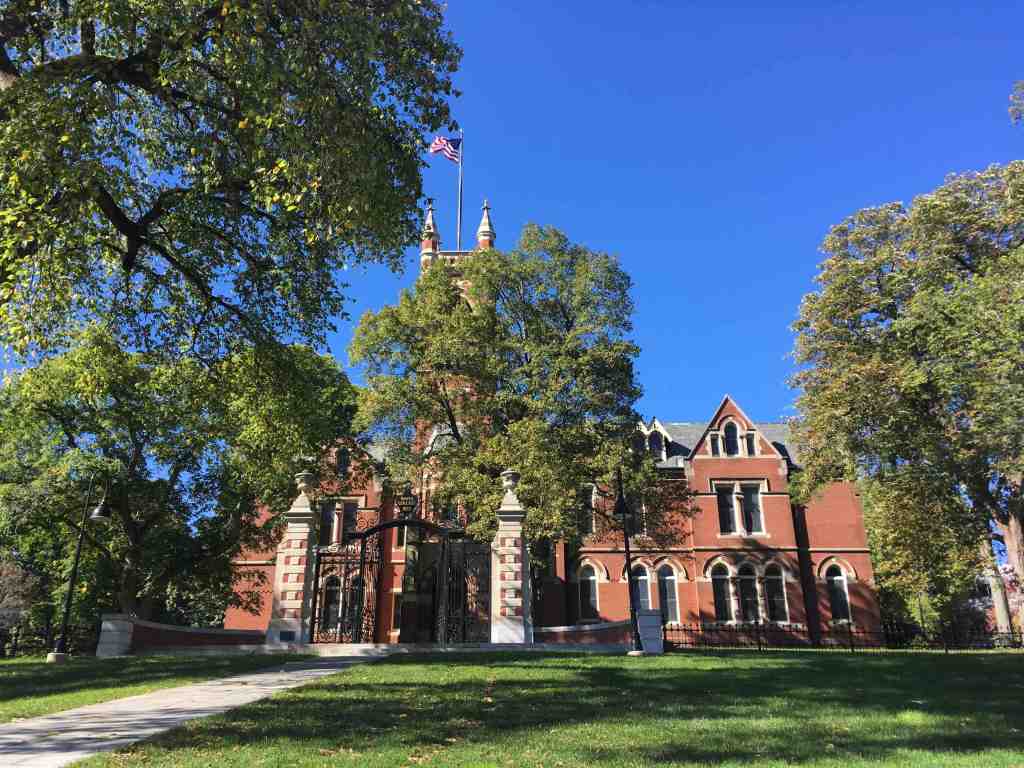
Amherst is located in Western Massachusetts, which is known for the close proximity of five well 
regarded colleges: Amherst College, Smith College, Mt. Holyoke College, Hampshire College  
and the flagship of the state university system U Mass, Amherst.  U Mask, Amherst?

Usually there would be thousands of students in the area but each school has significantly

scaled back or basically gone fully Zoom for pandemic academics.  Amherst feels like a sleepy 

college town with the iconic brew-pub (temporarily closed), art-house cinema (temporarily closed),

quirky restaurant-Judie\’s popovers (temporarily closed), artisanal ice cream shop (permanently 

closed), university museums https://www.carlemuseum.org (temporarily closed)  and 14 Asian 

restaurants within a 3 block radius. We have no idea if it really is sleepy or if it is just because there 

are essentially no students here yet. Can’t imagine what it will be like when the 27,000 students 

return (who knows when).   


A month ago, it was uncertain what was going to happen with the return of the students.  Even 

with that uncertainty, housing is limited and expensive in Amherst and very hard to find anything 

without a year’s lease.  From Oregon, we briefly FaceTimed with a potential landlord, felt

former-Californian connection and basically jumped in blind. We rarely learn from our past 

experiences, we did buy our house in Eugene from the internet.  


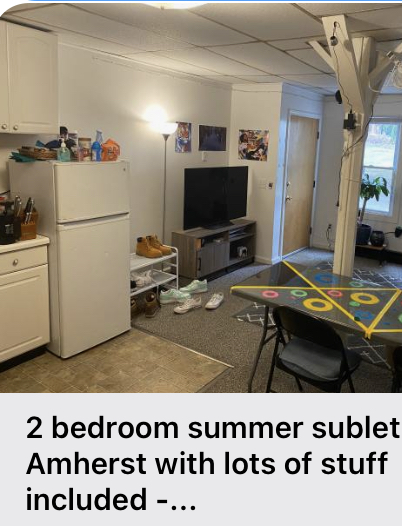
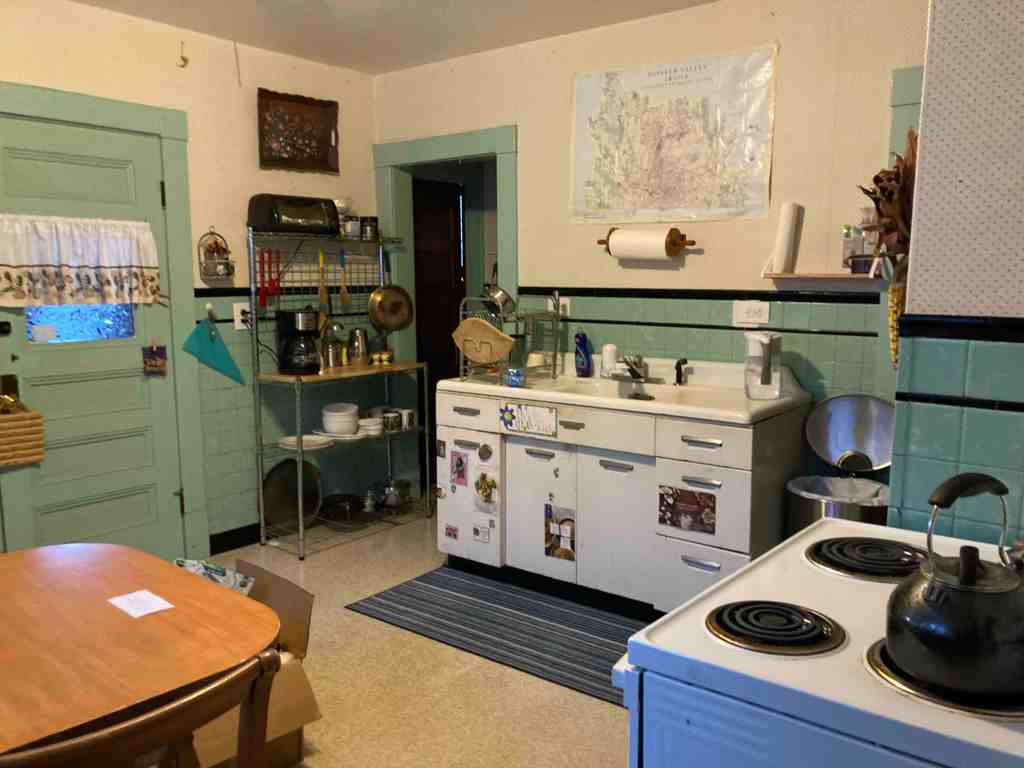
So our basement “garden studio\”, is located in a corner of a basement of a house (promising path to our entrance)


Immediately outside our room door, which doesn\’t fully close, are the stairs to the rest of the house.

Our room came with a futon and a college-dorm-style mini fridge. Patricia thought it was 

fine except for the bed and fridge, which is all it had. 

No kitchen, there is a sink but it is on the other side of the basement, next to the bathroom.   

We get there by traversing your typical basement décor of dust,  spiders, unidentifiable bugs that 

may or may not bite, boxes, dusty unwanted furniture, forgotten tools, paint cans, rugs, mattresses, water 

heater, roll of left over insulation, fuse box, an extremely large oil heating tank and  fireplace accessories. 

As with all traditional New England houses the washer and dryer are in the basement and for us, 

they are right outside our bathroom. Everyone upstairs comes downstairs to do their laundry. 

So we mask up to go wash ourselves or our dishes.  It\’s all rather awkward, even for us. 

We have called upon our experiences; our own and daughters\’ time in college combined with our

Eastern European Air BnB stays to create our home.  Added madras-like bedspreads on the wall, 

a microwave, electric teapot  updated the dorm fridge (they now come with separate freezer!) 

and an insta-pot (we are trying to learn new things).    

So we plugged in the yogurt maker and tortilla press and it now feels (almost) like home. Our hovel. Our buried treasure.

Didn’t think we would ever long for some of our more challenging accommodations in Europe,

but this basement has been able to do so. The ambience is further enhanced by the 24 hour background buzz of three fans, an air purifier and a de-humidfier (which almost drowns out the cicada) as they fight and lose the daily battle against the heat and humidity. .

The air is so thick, it feels like you are covered with double stick tape collecting sweat and bugs, 

bugs significantly larger then our west coast ones.  The ants are the size of dachshunds and the 

sow bugs are clad in Viking armor. 

The humidity also boosts the growth of trees, vines and grass and this verdant growth would be  

be really beautiful if the fear of ticks and Lyme disease had not redefined our definition of an 

attractive landscape.We look forward to  summer storms to ease the heat and have been 

rewarded with one tropical storm and two tornado warnings. 

Fortunately, we did not need to run to the basement since that is where we are living. 

Eastern Standard Time is not just a terrible weather time zone, it is terrible for the start of baseball

games and catching up on news.  We have a new respect for anyone who has lived on the 

East Coast. 

Our days, though, are full and make us happy to be here.  


We have made a lot of day trips to the Target and Whole Foods parking lots for curbside pick-ups,

and have explored a new Trader Joe\’s (consistently handling COVID well).  We’ve walked past the 

Emily Dickinson house, and her grave, both of which are the crown tourist jewels of Amherst.  


We sat with Emily and Robert Frost (another long time resident). 

We strolled through many neighborhoods, one consistent with the town\’s emphasis on poetry (not just Emily and Robert but Edward Field author of Winken, Blinken and Nod was another Amherstian). 

We walked through the historic neighborhood of Holyoke (birthplace of volleyball), but missed the

canals there (we missed Italy and Venice canals too)  There was a trip to the DMV (called RMV here for Registry of Motor Vehicles) in Springfield (birthplace of basketball) for Alivia to renew her license plus a stop and see dinosaur footprints.


We went to a Covid drive-by quilt show in cute Easthampton, or maybe it was laundry day. 

A trip along a little river (why does everyone pile rocks in the universal Girl Scout sign for 

danger?) https://www.washingtonpost.com/lifestyle/travel/rock-stone-stacking-hiking-cairns/2020/08/27/3059a9c8-e70d-11ea-970a-64c73a1c2392_story.html?hpid=hp_travel-right-4-0_travel-latest-feed%3Ahomepage%2Fstory-ans,

We have seen groundhogs (unfortunately one ate all our unripe tomatoes), chipmunks, bunnies, 

squirrels, a ton of really beautiful birds. No bears yet but others have reported sightings in town. 


What\’s next? More sweating and waiting until we can complain about the cold.  

We are effectively trapped in Massachusetts. Canada is closed. With our Oregon car plates, surrounding states are off limits. So we are (desperately) pretending that we are in Europe still as this old town, first documented in 1658 and incorporated in 1759, shares many characteristics with some of our favorite places in Europe. The classic town hall with clock tower

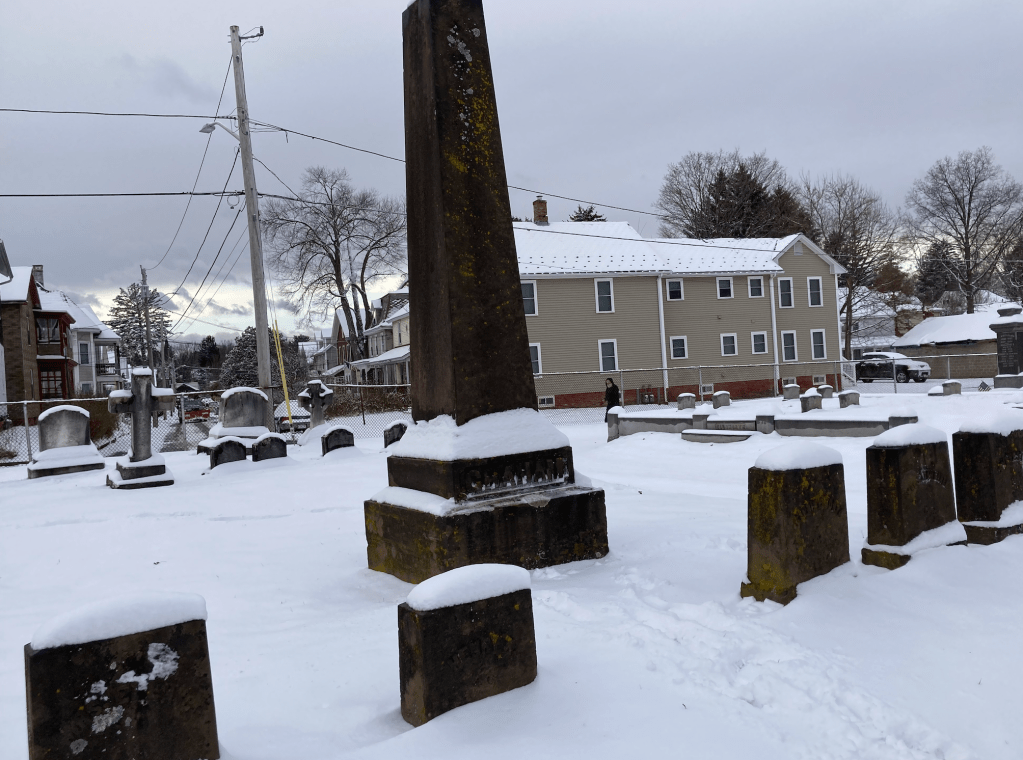
Old quirky cemeteries located  in the center of town, 

and in parking lots.

A  busy town square, not as picturesque as a German “Platz“, but consistent with the Yiddish  “plotz” which makes sense as the Yiddish Book Center is located here https://www.yiddishbookcenter.org

But reality sets in.  Tornado warnings, tropical storms, toll roads, Target pick ups, terrible time zone, no right turns on red, thousands of college students potentially ready to descend on the town constantly remind us that we are here in New England, USA. 

Driving to the End of the Rainbow

So that the site is free for us, there are ads. We don’t benefit from them, neither will you.

A rocky start, to our next fugue. Our original plan was to replicate our European fugue either in South America or Europe again, so much to still see https://thechosenfugue.blogspot.com/2020/06/we-will-always-have-frankfurt.html . We still rented out our house with the goal to begin a year-long meandering trek through the US/Canada to meet up with our daughter /son-in-law/granddaughter who were relocating to Amherst, MA from Saarbrücken, Germany. Unfortunately, we are living in (hopefully the last vestiges of) a Trump America where nothing is normal. Plans just can’t exist. Sur-reality has taken over. 


 For the returning ex-pats, it was a good-bye to a great German preschool  and low Covid rates  (a final maskless walk around her block) and hello to long flight with inconsistent masked passengers, although the 3 year old had it right. And, a dog in need of a tree.


So, in June, we successfully rented out our house, put everything we owned in our converted garage, bought a car, and loaded the car with everything else for daughter 1 in Amherst and daughter 3 in Minneapolis, a stop in route. We locked the door and left a week later then planned. 

Unfortunately we did not head to the majestic vistas of Glacier National Park and Yellowstone as hoped, but to the Best Western in Salem OR.  Fortunately, since our goal was to spend the year traveling and seeing America, our first stop was  essentially was Anywhere, USA.  A Best Western Hotel in Salem, Oregon. From our hotel window, we could gaze at the Costco across the street and the Denny’s in the shared parking lot. A stone’s throw away was Walmart, where we did walk to get the oak-barrel vanilla Talente gelato (one can pretend it was being eaten elsewhere eating After a vigor’s Chlorox wipe down of every surface, and replacing their sheets with our own, we were ready for our first meal of the American Adventure; a tin of red chile flavored smoked oysters, goat cheese plus zucchini, snap peas and basil from our left-behind garden.

Why Salem, Oregon. With no history, a few days before we were to leave, Nick was hit with kidney stones. 4-5 stones that needed to be blasted away which was problematic since Nick weighs 10 stone. With our house rented out for the next year, it was Kaiser Salem for treatment and a few day stay, followed by Hillsdale (just outside of Portland) for recuperation.

plaid shirt
Got the dress code memo

After kidney blast off, we traded our Denny’s parking lot for a business center Hampton Inn for a few days and then hit the road with a lovely Oregon sendoff.

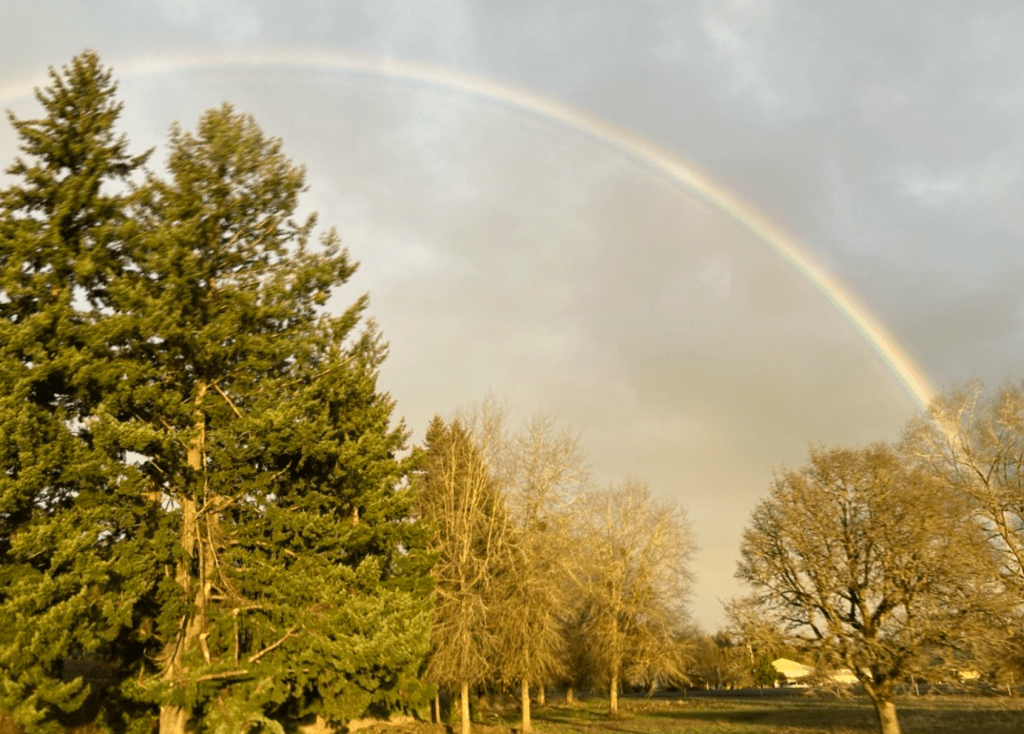
Trying to make up for lost time, and concern for exposure, we abarrled through Oregon, Washington, Idaho and half of Montana, making it to Butte the first night. We finished crossing Montana, to spend the second night in Jamestown, North Dakota, birthplace of Nick’s father. Like all of North Dakota, it was remote and sparsely populated. It’s understandable that his father never went back after leaving for college. We were graced with a nice send off- a tiny rainbow, just under the cloud to the side of the Mac sign.

 Seen from the car, Montana and North Dakota were really beautiful.

Based on our amateur sky observations we determined that North Dakota’s sky was almost as big if not equivalent to boastful Montana’s sky. As we passed towns with known names (Missoula, Billings, Butte, Bismarck) it was a bit remarkable how small they all were, and yet they all seemed to have a Walmart and a Denny’s.

We also began our train spotting as we entered Montana and we were really struck by the number of long trains in each state as we sailed across the country to Amherst. 

We rolled into Minneapolis  for 3 days to visit our youngest daughter Simona for a very enjoyable tour-break.  Our stay here was in the guest room of Simona’s building- an iconic Co-op apartment building (she rents) built in 1930 to be the fanciest apartment building in Minneapolis. It felt like a combination Del Coronado + Fountaingrove Lodge https://thechosenfugue.blogspot.com/2019/10/living-lodge.html tempered with the faded glory of Sunset Boulevard (movie not street).

She was very pleased with her recent move here especially nice as she has rarely been able to leave her apartment since she moved in on the first night of lockdown. 

The Twin Cities is in a major state of flux and recovery.  Driving around the protest signs were encouraging , yet the empty and boarded up buildings a reminder of how much needs to be done. 

Yet again, we were given a stellar send off, this time from outside of Simona’s kitchen window

After the Twin Cities, we did a marathon 14 hour drive to Erie, PA  trying to quickly get through Wisconsin, Illinois, Indiana,Ohio and Pennsylvania (just a sliver), with their confusing toll roads. As Californians,  we were raised on freeways and not used to toll roads/turnpikes. Considerable amount of high anxiety resulting from toll booth confusion and a sense of imprisonment with the toll road guard towers, well maybe they were actually tollbooths, at each exit. We raked up $43 in tolls while we were road-trapped.  Although the toll roads seem to skirt the cities, we did manage a brief side glimpse of Cleveland and the baseball stadium (Progressive Field). 


An overnight stop in a rural NY oasis to visit Patricia’s sister + brother-in-law and enjoy a room that did not need to be Chlorox-wiped/stripped down plus a meal which included greens from the garden and grilled haloumi- a better reminder of past travels then the ice cream at Walmart.  It is a pretty idyllic spot. 

Our only tourist stop on the journey was Watkins Glen in the Finger Lakes area. https://parks.ny.gov/parks/142/  (check for more pictures). A crazy naturally sculpted sandstone and limestone gorge, like a combination of Frank Lloyd Wright, Disneyland’s Swiss Family Robinson and Nirvana (the state of mind not the band, or both because it wasn’t really hard rock). 

Unfortunately, it was tainted by crowds which included many unmasked people, despite signs stating masks required and presence of park rangers (although they did not seem to be enforcing). It felt like a big open bar, so we moved quickly.

After 10 to 14 hour drives, the last day\’s 3.5 hour sprint to Amherst went quickly.  More trains, more tollbooths, then Massachusetts and more tollbooths.

We drove up to our daughter’s house, the end of the rainbow, dropped our remaining cargo  for them in their driveway and then drove off to wait for their 14 day quarantine to end. 

We will always have Frankfurt

So that the site is free for us, there are ads. We don’t benefit from them, neither will you.  This was also a pre-WordPress update, sorry for how bad it looks.

While we usually post soon after we visit, circumstances this year got in the way.  
Revisiting our last stop on this fugue before starting a new one domestically at the end of this month.   
We had passed through Frankfurt several times utilizing both of it\’s airports and train station as a transfer point without seeing it.  Like Luxembourg we felt it deserved some attention.
A very short stay in Frankfurt as we prepared to leave Europe again, hoping to come back in a few months. Arrived late to a very silent weird dorm/hotel/airbnb, very efficient with an odd cube of a bathroom in the middle of the room. Don’t know if was knowing it was the end of travels for awhile or just the disorienting nature of empty streets, but Frankfurt felt kind of surreal.  Germany believes in extending it’s Christmas holidays, so the streets remained empty.  An early morning wake up and walk through a rather cold and seemingly deserted city did nothing to dispel the Twilight Zone feel of the day.  An eerie foreshadowing of the year ahead perhaps.
What also was disorienting was trying to figure out what was really an old building or a very good reproduction as Frankfurt was pretty much demolished during World War II and afterwards sought  to change the narrative and just redo what had been.  They did a good job, at least we could not tell.
What is new is old again
New in 1880 Opera house, made old in 1981.          Medieval city gate now a modern coffee house.
In the \”new\” old town, parts of the Römer city hall are 600 years old
Actually rather new
As with most German cities,  the built environment is complex.  Each building has convoluted history as does each sculpture.   We wandered through a chilly city sculpture garden, finding Den Opfern (the victims) by Benno Elkan from 1920, memorializing World War I.  It  now does double duty also memorializing World War II as it was removed in 1933 by the Nazi\’s (Benno was Jewish), but was replaced in 1946.

So of course, like all German cities, that brings us to Frankfurt\’s Holocaust memorial.  Another rather complex story addressing\”how do you consider the past while living in the present\”?   This is especially relevant in Germany where  many Germans felt they were victims of Nazism as well. Seems like everywhere we visited, not just in Germany, but any country that was complicit, these memorials were created only in the past 15 to 20 years amidst controversy.

Frankfurt\’s story is that the ruins of the medieval Jewish ghetto were uncovered while excavating to build a new a city services building. https://en.wikipedia.org/wiki/Memorial_Neuer_B%C3%B6rneplatz
The argument discussion regarding whether to keep on building or stop and preserve was intense, with the eventual resolution of creating a Jewish museum built upon and including the ruins.  Another Jewish museum is associated with the Rothschild Palace  (home of the Rothschild family) . https://www.juedischesmuseum.de/en/visit/museum-judengasse/.
A gripping memorial wall was built along the remnants of the old Jewish cemetery next to the museum.  The wall contains names of the 11,000+ Jews forced to leave Frankfurt.

Anne Frank, born in Frankfurt
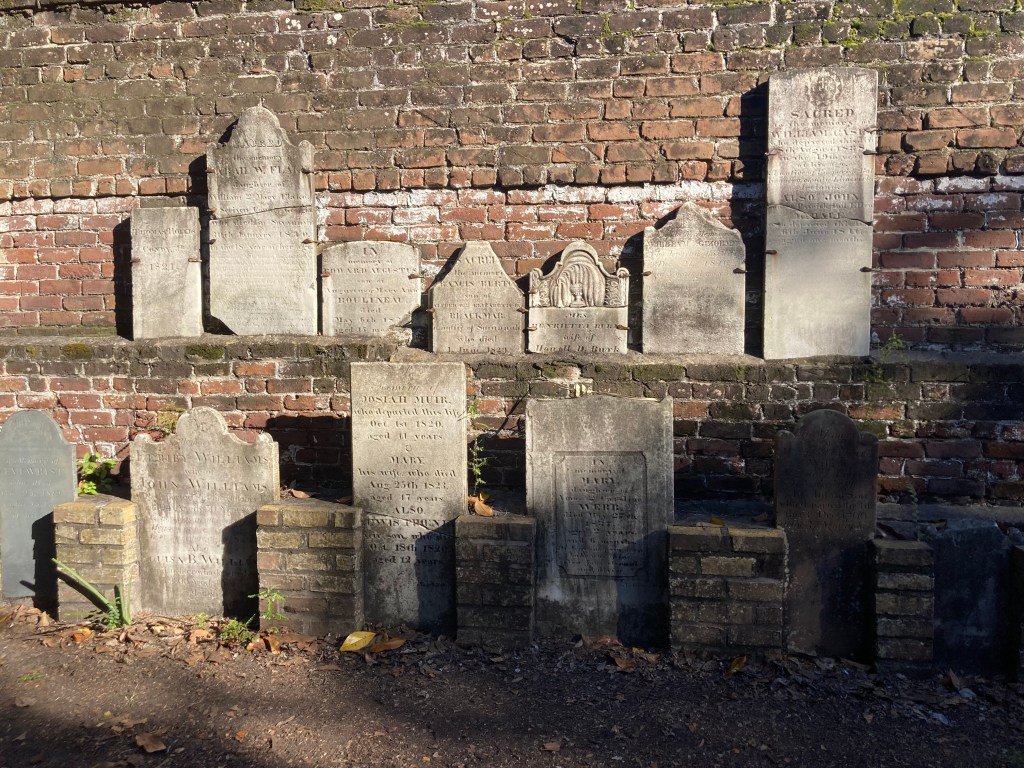
The wall went around the block surrounding what had been the Jewish cemetery.  Tombstones that had been found were lined along the back walls, impossible to know which graves they belonged to.
Frankfurt also had it\’s fair share of stopelsteine https://thechosenfugue.blogspot.com/2019/01/they-do-make-you-stumble.html
After our stroll through the historical center of the city, we walked back along the river, marveling at the buildings, the river Main and appreciating this really beautiful city like so many we have appreciated over the past year and a half.
And while we skipped most of the industrial, financial portions of Frankfurt, at the end of a lovely path, we did catch this reminder that we were in the financial center of the European continent, home of the European Central Bank.  Fitting that on our last stop we were already looking backwards at the Euro.
We spent our last few euros at a little market, buying an assortment of odd things for dinner (again, VERY typical of our travels), and strategically, a bag of clementines plus chocolate for our flight.  Then woke up to a magnificent sunrise and left for the airport.
We will always have Frankfurt. That wasn\’t the plan but this might be the last European sight we see for some time.

Our Frankfurt-Seattle-Portland-Santa Rosa flight had a bonus  overnight in PDX.

Leaving Frankfurt, 11 hours to Seattle, 4 hour layover in Seattle, Sleeping on the new, famous PDX carpet.
Greeted well upon our landing in California
Writing this from Eugene, Oregon in June,  we really appreciated our year and half on the road, and now planning a new fugue with a cross country car road trip at the end of this month and hoping that all gets better soon…

Cologne not alone for Christmas

While we usually post soon after we visit, circumstances this year got in the way. This post is exceptionally fun as we get to experience Christmas in June. 

Advent marks the official beginning of Christmas Market season in Germany. We went to our first Christmas Markets about 10 years ago on a trip to Vienna and Berlin. While we saw many different iterations throughout Europe, Germany seems to take special pride in their Markets.  

Metz, France – adjacent to Germany

Typically Christmas markets surround the town square or pedestrian street with decorated booths. While each town and country have their own unique spin, and almost always highlight local products, you will pretty consistently find  mulled wine of some kind,  local honey or jam, wooden toys/knick knacks of some kind, knitted hats/gloves of some kind, some kind of Disney related item, and then food-pretzels, meats, sausage, candy, and cookies. (More Metz)

While the market have become major tourist attractions, they still feel pretty local.  This was really felt in the ruckus of opening night of the Advent Market in Reijka https://thechosenfugue.blogspot.com/2018/12/pula-treiste-and-rijeka-istrian-trilogy_4.html and the more intimate Advent evenings in Zadar https://thechosenfugue.blogspot.com/2018/12/pula-treiste-and-rijeka-istrian-trilogy_4.html.

Everyone was either singing and dancing fueled by  drinking Gluwein, which ranged in flavor from warm Sangriá to warm Dimetapp. Most towns  had shows for children and  rides, enhancing the feeling like you were at an elementary school carnival. Made you feel the nostalgia that probably every German/Croatian/French/Austrian feels anticipating and going to the market. (Saarbrücken)

And of course there is food, lots of food. Reibekuchen/kartoffelpuffer (potato pancakes),kartofellanzen (potato spirals), flammkuchen (flaky pizza), wurst (sausages) and more wurst, all kinds of cheeses-fresh, fried or melted over anything, candy, cookies, roasted chestnuts and almonds, jacket potatoes (the best ever was in Metz, France), all washed down with hot (mainly) alcoholic drinks.

As you can maybe see, most markets have their own specially designed mugs.

It really didn’t matter what town, what country, the food pretty much was consistent with the exception of the uniquely German little bread guy with a pipe.

This year we had an early bird German Christmas market preview on our visits to Worms and Luxembourg, and in Saabrüken, watched Santa flash across the Christmas market with baby Jesus as his co-pilot riding under the sleigh in a foil wrapped potato, consistent potato theme.

Despite the tension of the baby Jesus transport, we were not prepared for the Christmas Markets in the Cologne/Bonn/Dusseldorf corridor. We should have realized something was coming based on the sheer number of Santa hats and bottles of Sekt (German Champagne) we noticed on the trains; morning, noon and night. Typically, the Markets are in the town square, but in these  cities they seemed to exist at every turn, each with a different theme. Market hopping!  It was a Nativity scene!

We started with a tram ride to Bonn, to see Beethoven’s house and museum,

Then we took another short ride to Dusseldorf;  the Mother-Mary-lode of Christmas markets. Between the two cities we strolled through a gnome themed Christmas market, an alpine themed Christmas market, an angel themed  Christmas market, an Ice Palace themed market (Frozen?), … etc. Basically a loop of booths of things you don’t need to buy, you don’t really want to eat, followed by a cup of Gluwein in a unique-for-place collectible mug, another lap, rinse, repeat- becomes a drinking game with a side of knick-knacks.  In Dusseldorf alone it was 4 or 7 or 10 markets (we don’t remember- it was the Gluewein) in a 2 mile radius. Prost!

The Christmas markets were just part of our very Rhine valley experience.
Christmas dinner was at a  traditional German restaurant. We knew it was traditional as all of the vegetarian dishes had bacon in them.  Plus, they just kept filling up your cups with beer.  Since Köln is known for Kölsch beer we thought it was all complementary until we learned you need to put the coaster on top of the cup to get them to stop pouring.  It took us awhile to figure that out, but after our laps of Gluwein, we were well trained for bottomless Kölsch.

We passed a few stolpesteine, this was in front of what was a gay bar during the Weimar, he was a female impersonator and called it a night.

The next day we were ready for the main Köln attraction, the Cathedral, which like most of the city was heavily damaged in the war.


Köln, like most of Germany, shuts down for about 3 days around Christmas, so when not market hopping we were window shopping at the unique stores immediately around our apartment.   This included  a store exclusively selling cutlery with eight large  picturesque storefront windows of cutlery and a store exclusively selling religious objects and priest frocks (The Holy Men’s Warehouse?). You can virtually shop there now to avoid the pre-Christmas rush right here https://www.youtube.com/watch?v=p1SW7RSb3vY

Most interesting, was a the James Dean water bottle. 

 
We said goodbye to the stateside group going on to Amsterdam, to our German crew (plus Santa looking a bit groggy) going home to Saarbrücken and we went on to the last stop on this ride… Frankfurt


(Thank you Trevor for the additional pics)


The Left-Overs

NOTE: THIS WAS ORIGINALLY IN A DIFFERENT PLATFORM AND WHEN IT IMPORTED IT MADE IT LOOK AWFUL. SORRY.So that the site is free for us, there are ads. We don’t benefit from them, neither will you. 

We got out of our rhythm of recapping our travels, but we will try to retrace our steps.
What seems a lifetime ago, but only a little over 6 months ago (in mid November) we headed back to Germany for the duration of the 2019 year.

We escaped the retirement home cocoon for the next step in our life cycle- Worms.  Worms, Germany. We tried to catch Worms earlier in the year but we got off track and missed the train connection in Mainz.  To get to Worms you have to change in Mainz, so we gave Mainz a second chance as our last visit was rather unremarkable despite solid recommendations about the town.  We thought maybe we missed the Mainz attractions, we didn’t. Although, this time through was opening day for Christmas Market season, which was apparent based on the number of train travelers wearing Santa hats and drinking bottles of Sekt (sparkling wine) for breakfast.  The draw for Mainz was that it was the home of Johannes Gutenburg, the inventor of the moveable printing press, but we thought it was nothing to write home about.
Note: After spending 3 months at the retirement home, we forgot how to use our cell phone, so not as many of our own pictures.
Fastnachtsbrunnen or Carnival Fountain

From our home base in Saabrucken in the Southwest corner of Germany, we were neighbors to the home of pivotal movements in modern religious history.  We figured it was worth a day trip, so we finally made it to Worms.
The City of Worms is considered along with Cologne and Mainz,  as one the oldest cities in Germany, after Trier, the oldest (https://thechosenfugue.blogspot.com/2018/09/day-trippin.html)
Worms has the  oldest surviving in situ Jewish cemetery dating back almost 1000 years to 1058, relatively still intact. The “ShUM”, the cities of  Worms, Speyer and Mainz were where Ashkenazi Judaism kind of took off in the 10th century. https://whc.unesco.org/en/tentativelists/5975/.  Like most German towns, not much is left  to identify the medieval Jewish ghetto but in Worms there was a tiny little synagogue, home of the famous scholar, Rashi. Although we skipped Speyer and skimmed Mainz we did enjoy the deeper dig in  Worms.
Holy Sands-oldest Jewish Cemetery
Worms: Rashi Synagogue
Stolpesteine in Worms https://thechosenfugue.blogspot.com/2019/01/they-do-make-you-stumble.html

The next religiously significant event in the history of Worms occurred on the goyish side of town, half a millennium later, in 1521 Worms was the site of the tribunal of Martin Luther when he appeared before the Diet (assembly) of the Holy Roman Empire in what was called the Diet of Worms and Luther was declared a heretic-the Edict of Worms.

Martin Luther in Worms

But Worms like most of Southern Germany remains decidedly Catholic with the old, traditional churches with also some interesting  modern touches (Freedom for Kurds).

Finally the other big cultural draw is that Worms is one of the geographic stars of the Nibelungenlied, the German epic poem from the 1200s celebrated in Richard Wagner’s Der Ring.

Niebelungenlied Dragon
Worms integrated the very, very old with the new as with most of the Rhine and Mozelle valleys, the cities were heavily damaged in the war. (confession did not take the pic of the medieval gate but we did see it.)


After our religious history field trip, we cut bait, and returned to Saarbrücken and planned our next get-away.
The Grund Area (lower Luxembourg)

LUXEMBOURG CITY
Luxembourg was another city/country that kept eluding us having passed through it by bus, train and plane, and, even after spending 2 days there it still eluded us.  It was lovely, but if you threw Dutch, French, German and Flemish cultures against a wall, and nothing sticks, but the mark left  would be Luxembourg.  A pleasant mark, but ill defined.  Luxembourg City was the Zelig of cities,  eight blocks of feeling you were placed in a witness protection program due to mistaken identity.  And, Luxembourg historically is well protected with the Bock Casements (17 km’s of tunnels and cannon perches).  We were only able to view from outside as it was closed to tours. They are better explained here: https://www.atlasobscura.com/places/bock-casemates%C2%A0

Bock Casements (picture from Atlas Obscura)

The city itself was a layer cake with essentially three parts- the ramparts, upper city, the lower city and within the lower city the Grund. Each a different flavor, attractive but incongruent.
The City layers seen by Wikipedia

We did find an answer though to this enigma of a city in the National Historic and Art Museum.
Consistent with the city, the museum combined a variety of architectural genre-  the modern front looks out over the traditional “Fish Market” square and the back is attached to three old houses repurposed as exhibit space.  Again, consistent with the city, the space was disorienting- we have experienced switchbacks going up mountains but never before in the interior of a museum.  Stairs that somehow, brought you back to where you just were.
The bottom floor housed Roman ruins, middle floors a collection of coins, tools and weapons, top floors special exhibits- all very pan-European.  Crossing a glass bridge you enter the three connected houses. These were a warren of rooms filled with various styles of “arts and crafts”, furniture- most NOT from Luxembourg, and then finally a room of interesting Luxembourg artists (3 of them), who all oddly died young.  But the answer to our quandary of what is Luxembourg came in a museum education card describing their country’s style- they don’t have one as most of their royalty and noble class did not live there and everyone else was too busy working.

Ramparts above the lower city

But Luxembourg was a beautiful city and we did feel pretty accomplished that we finally made it there.

Christmas Market
A Forest just kind of in the middle of everything.
 
Also an oddity of Luxembourg is they vote with their butts.

A fitting end as our bus passed by the home of the master planner of our trip, the city of  Schengen, where the agreement that dictated non-EU citizen visa requirements.   See the link for more info  https://thechosenfugue.blogspot.com/2018/10/schengen.html

Schengen!

Living Lodge

After an exhausting year of traveling, we needed some R&R, a couple of months of relaxation before we hit the road again in Mid-November.So we checked into a rest home.

We have spent the last month convalescing with our soon to be 90 year old mother/mother- in-law at her luxurious retirement lodge.  
Our day begins leisurely,  aware that the mail would not arrive until the late afternoon.  We fill our days watching the TV on high volume, going to tend to her garden plot aka garden space (it’s preferred we don’t use the word “plot” but that’s what it is).  

Pool is an option either swimming or billiard.

We could play ping pong, or read  newspapers in the”Bistro”  area- where coffee, tea, fruit, infused water and Otis Spunkmeyer cookies are always available (top left). Or read in the library (top right). By now it is 11 am and the mail is only hours away (center).  Flower arranging is possible on Saturday, which essentially is picking up free flowers in the activities room which are donated by Trader Joes (they were going to toss them but gifted them instead).The on-premises bank is available, but we just use it to pilfer the free cookies (bottom left), timing is essential, 


 We are sharing her food plan with monthly points, so strategic planning of meals is required.   The weekly specials are posted beginning on Sunday so  plenty of time to formulate our approach.  Regardless, the food is plentiful and generally tasty with just enough borderline items allowing for hours of post-prandial analysis (“veal scallopini ? more like leather scallopini).


We can stop in at the tavern for a drink (using  free drink coupons won at the twice a month Tuesday Bingo games).  

A different movie is shown (twice) daily, in addition to crafts, we can join into mahjong games, cards/poker, storytelling, puzzles, board games, and drum circles.  A large chicken coop provides free eggs. 


Chickens are all named after famous lesbians. This morning visited by wild turkeys.

Schedule a haircut in the beauty salon, or a massage as the mail is still hours from arriving. Seemingly, almost daily Doctors’ appointments fill our social calendar, otherwise we discuss with our neighbors our chronic aches and our new pains.   Of course, each day is special but some days more so than others. 


The housekeeper comes on Mondays at 1pm sometimes 2 pm, close to the time people start to gather around the mailboxes in anticipation of the mail arriving anywhere between 3-6 pm.  You have to check both the cubbies AND mail box
Hopefully, mail arrives by 4:30 so that we can get to the dining hall for a late dinner.


kids came by for a visit

After the mail finally arrives (just junk, as usual) it’s more loud TV, or more recently the gym to exercise to Star Trek reruns (where we ponder deep universal questions like- Is evil present in all galaxies?  Why is Captain Kirk always the only one without a shirt on?  Why do most planets where no man has gone before always look like Chatsworth in the San Fernando Valley?)


The day winds up with a call in to Germany for the daily performance of Grandparent Theater:

Tonight\’s guest stars: Gma, Bert & Ernie

“The Papou and Yaya Show”


Last week: On the Road live from Minneapolis with guest star Simona

And then we fall asleep listening to the coyotes howling, hooting owls and Wacky Warren next door.   Tomorrow is Wine Wednesday, and per Wild Bill from the second floor we will all wine and whine.

Munich

This post was done prior to a WordPress upgrade, looks kinda bad. Ads make this free but no one benefits.

It is hard not to sound repetitive. Every place (okay, maybe not Ayia Napa, Cyprus) has us saying, this feels better than home.  Pretty much everywhere has felt safer, more livable than the US (gun control, please, please, please). The challenge of each place while  unique,  is usually the history, and unfortunately even that sounds repetitive.  Over and over the past is inequality, capriciousness and persistent cruelty of governments tempered by people\’s perseverance in seeking self-determination and maintaining culture.Germany though has had the highest highs and the lowest lowsWe have loved Germany. It is stupendously beautiful; countryside and cities. Forest, hills, valleys dotted with Fantasyland villages.

Cities are clean, services plentiful, people are courteous, public transportation good.  There are walking trails and pedestrian areas everywhere, forests at the edge (or even center) of almost every city. recycle spots every few blocks.  Food is fresh and reasonably priced.  Nick would move to Freiburg im Breisgau, yesterday. 
https://thechosenfugue.blogspot.com/2019/07/black-forest.html
The country generally is progressive, environmentally conscientious and makes serious attempts at reconciliation with their history. 
Munich was extremely nice, seemed very livable but also underscored the frightening world we currently live in as we examined it\’s not too distant past. 
Like most German cities, there was significant destruction from WWII bombing (Munich was hit particularly hard) so building styles were very inconsistent; old, new and reconstructed. 


Alte Pinoktech Museum, you can see the repaired brick
Like most European cities, Munich had a town square that was anchored by the city hall, the Rathaus, but Munich’s  had an animated clock performing, three times a day,  that attracted a large crowd. 

The inside was as beautiful as the outside,


Inside were also tons of tributes, kind of a city time-line + yearbook going back hundreds of years.


and of course, a cafe in the courtyard.

Around the Rathaus were fountains and statues in the main square (Marienplatz)

and on the streets radiating from the square, beautiful churches with a few different twists (best door knobs ever seen).

Munich had murals and palaces;

and a popular, huge park (English Garden) with a river (Eisbach, side-arm of Isar) where you can surf (with people waiting very patiently for their turn- no supervision, no  cost).  https://www.vice.com/en_us/article/3d9way/welcome-to-munich-the-mecca-of-river-surfing


Rainbow and brown trout


Museums were amazing and varied.   We saw many favorite German artists and were introduced to some new (to us) artists

Georg Baselitz, new favorite
Yes, he painted upside down, well his paintings not him
Design exhibit
At the museum, the historical shadows started creeping in. It was hard to just appreciate the art, in light of the history of Nazis looting art (https://en.wikipedia.org/wiki/Nazi_plunder), we began to feel how that period of time permeates and still resonates.
Seen in a Munich park

With the current world situation with so many populist leaders, it was difficult revisiting the origins of the Nazi party at the Munich Documentation Center for the History of National Socialism, opened in 2017 on the footprint of the former Nazi headquarters
(https://www.ns-dokuzentrum-muenchen.de/en/documentation-center/historical-site/ )  The exhibit charted the beginnings of Nazism onwards through today in modern Germany and Europe.  Early Nazi propaganda and practices unfortunately mirrored our current news- it was so disheartening watching history repeat itself countless times as we wandered through Munich\’s monuments and museums. The similarities were so frightening.

Our discomfort wasn’t really with Munich but  as it was the epicenter of Nazism in Germany (as well as the anti-fascist resistance), there were frequent reminders of people\’s cruelty  and how it feels like we’ve learned nothing.
It was encouraging  to see kids  accessing historic sites;  young kids on field trips in the old city center, numerous groups of teenagers in serious sit down talks with teachers around exhibits at the Munich Documentation Center for the History of National Socialism, and at Dachau, and most poignant- a group of physically handicapped young adults, who would not have existed under Hitler,  at the University\’s memorial to the student run White Rose anti-facist movement ( https://en.wikipedia.org/wiki/White_Rose).
In front of the White Rose Museum, flyers embedded in the ground placement as they were when the University students and siblings Hans and Sophie Scholl threw them as they were arrested and then executed in 1943

Dachau was vast. It was unimaginable to think how many lives it once contained, controlled and eliminated. They said the biggest problem was overcrowding yet the space was massive and to realize it wasn’t big enough for the volume of lives that were abused and lost, devastating.

Unfathomable just considering the uncertainty experienced by the prisoners, especially with death everywhere. The barracks, the claustrophobic cells, the horrifying crematories but nothing more frightening than the open space, imagined crammed with people awaiting the worst.
Described by a survivor, the 2 mile walk  from the Dachau train station to the camp, was punctuated by the incongruity; through picturesque forest and natural beauty to the ghastly and dehumanizing destination. path remembrance Dachau
Although we all are familiar with the horrors of the concentration camps, being there just emphasized that, from our frame of reference, we can never really be familiar, never can completely comprehend the experience and inhumanity.
Stopelsteine in Dachau, the city, about  a mile from the camp
Dachau, about 10 miles north of Munich, was the first concentration camp.  It opened in 1933, and was actually used initially for political prisoners (anti-fascists, communists, partisans from invaded countries), which ultimately was anyone opposed to the new Nazi government including clergy, as well as “undesirables” such as Sinta/Roma, homosexuals, Jews, mentally and physically handicapped.  Initially, the camp also supplied needed labor for the country.  Jewish prisoners weren’t really the majority until the late 30’s.Both Dachau and the Documentation Center admirably emphasized the absolute lack of individual accountability for the majority of Germans- soldiers, politicians, civilians.  And that was the challenge of Munich, it was where the Nazis got their start and power but how does a city acknowledge and repent?   Part of the problem is many of the buildings used by the Nazis were destroyed in the war and identifying those sites or existing buildings for educational purposes has been controversial.   Munich is stuck between pointing out Nazi sites while preventing Neo-Nazis from congregating and revering them.

The 1844 memorial to fallen German soldiers became a Nazi icon since it was  the site of the Beer hall Putsch, when Hitler tried to take power in 1923.  Munich has had to balance preserving this monument and preventing Neo-nazis from celebrating it. During the Third Reich, anti-fascist Germans would walk behind it so they would not have to salute it as required by law (alley is called Shirker’s Alley)
In front of a store, not on the street
Munich continues to struggle with competing groups; those wanting to diminish or or rewrite history,  those wanting to just move on and those wanting more public accountability. This is exemplified by Munich\’s  lack of  Stolpersteine. https://thechosenfugue.blogspot.com/2019/01/they-do-make-you-stumble.html The city banned them, only allowing them on private property. Munich’s Jewish community president was not supportive of them although the German Council of Jews and many other local Jews and  Germans were.  Munich’s alternative, started in 2015, were 5×5 plaques (not much different then an address nameplate) somewhere on or near the house but when we went to find some, it was difficult and we couldn’t. About 50 exist, and as with the Stolpersteine, memorializing not just Jews but all victims- people with mental illness, physically disabled, Sinti/Roma, gay, Jehovah’s Witness and the resistance.  In contrast to the Munich ones, the Stolpersteine seem to more accurately reflect the proportionality of the groups victimized.
(https://www.muenchen.de/rathaus/Stadtverwaltung/Direktorium/Stadtarchiv/Erinnerungszeichen/Biografien.html.
Each day after being  overwhelmed by the contradictions of history and present day, we returned to be rejuvenated by our hotel in the very ethnically diverse upbeat Little Istanbul area of Munich, very much appreciating our Turkish/German hybrid Hotel Goethe and the surrounding neighborhood.

So, Munich kind of encapsulates our (thus far) European experience; contemplating it\’s  tragic and violent history against the backdrop of wondrous natural beauty, inspiring art and and persistent resistance, unfortunately often futile.
We’ll continue to try to ride the wave of optimism.