Living Lodge

After an exhausting year of traveling, we needed some R&R, a couple of months of relaxation before we hit the road again in Mid-November.So we checked into a rest home.

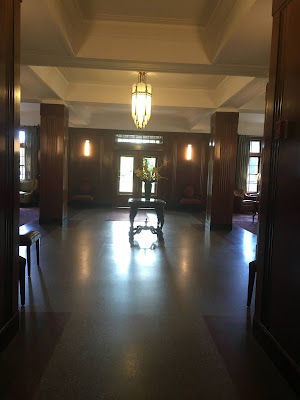
We have spent the last month convalescing with our soon to be 90 year old mother/mother- in-law at her luxurious retirement lodge.  
Our day begins leisurely,  aware that the mail would not arrive until the late afternoon.  We fill our days watching the TV on high volume, going to tend to her garden plot aka garden space (it’s preferred we don’t use the word “plot” but that’s what it is).  

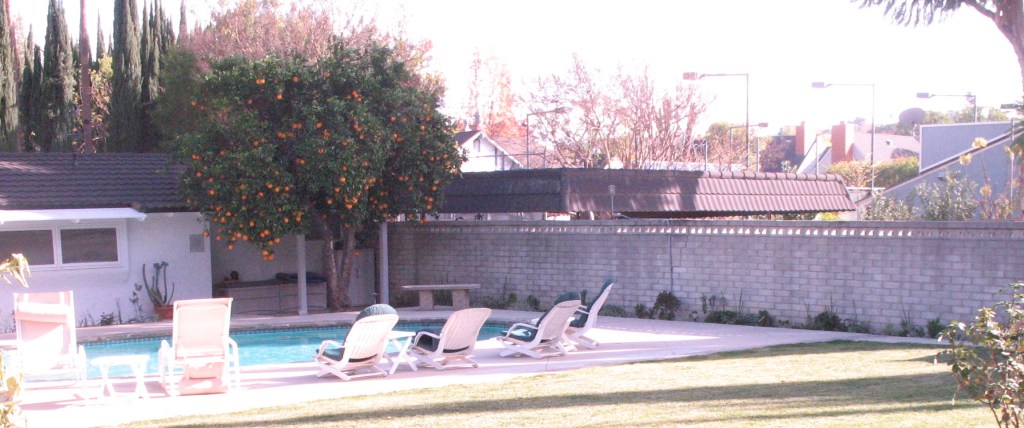
Pool is an option either swimming or billiard.

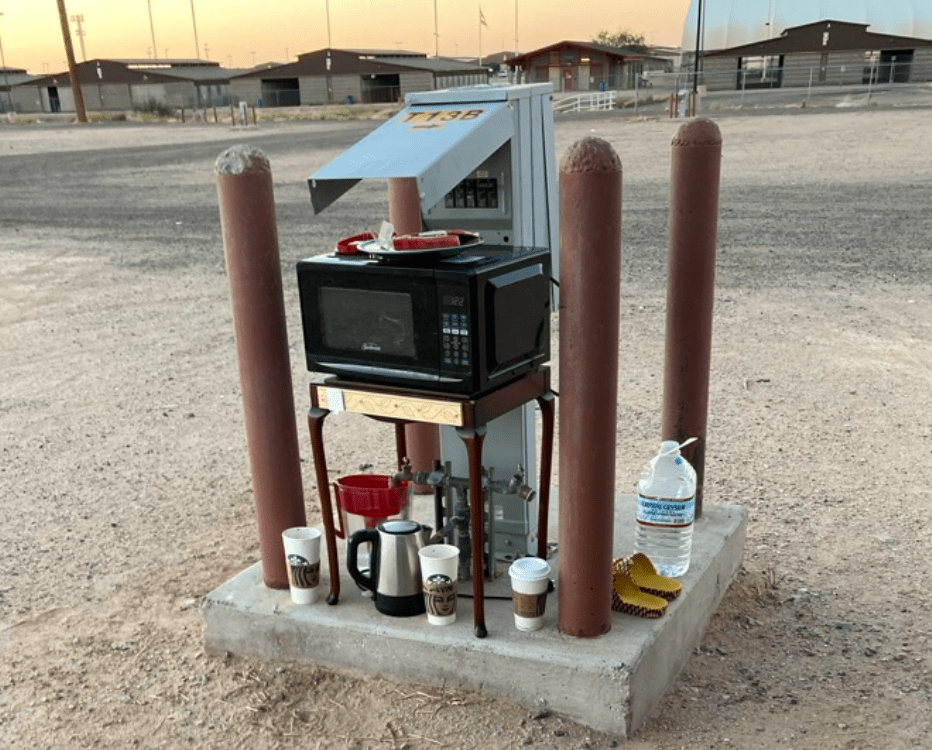
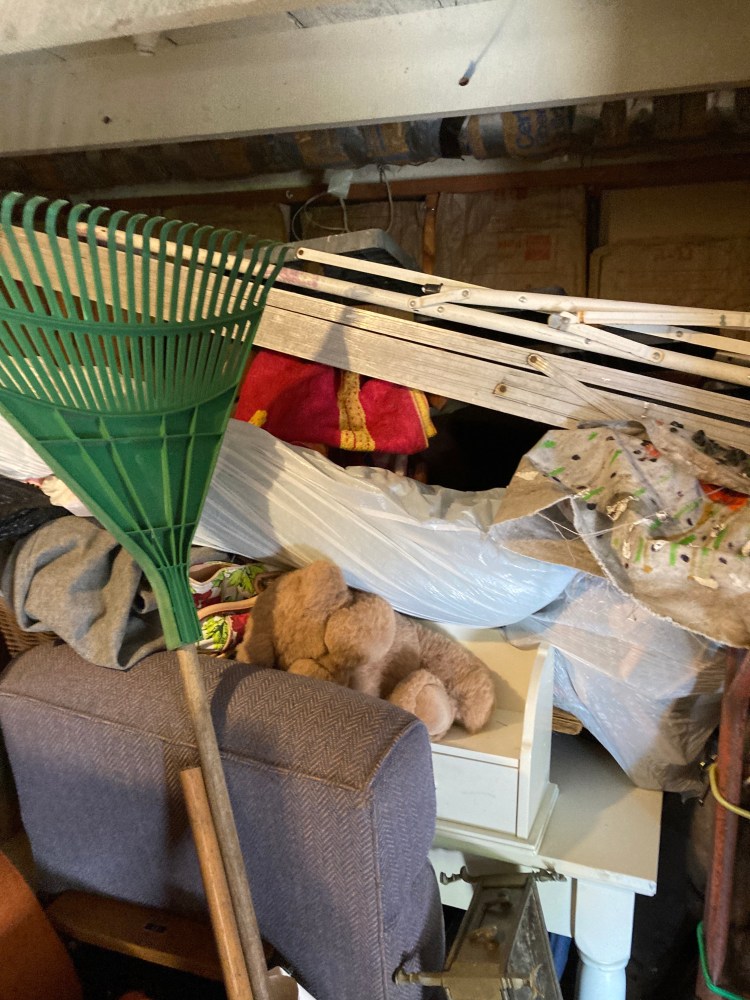
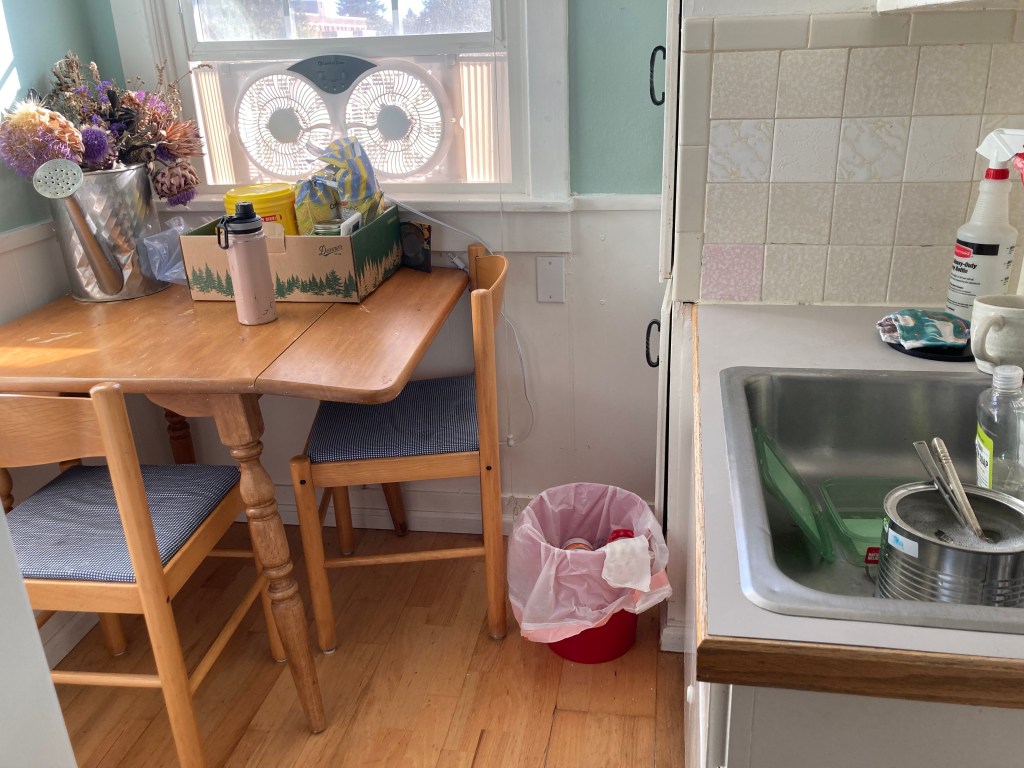
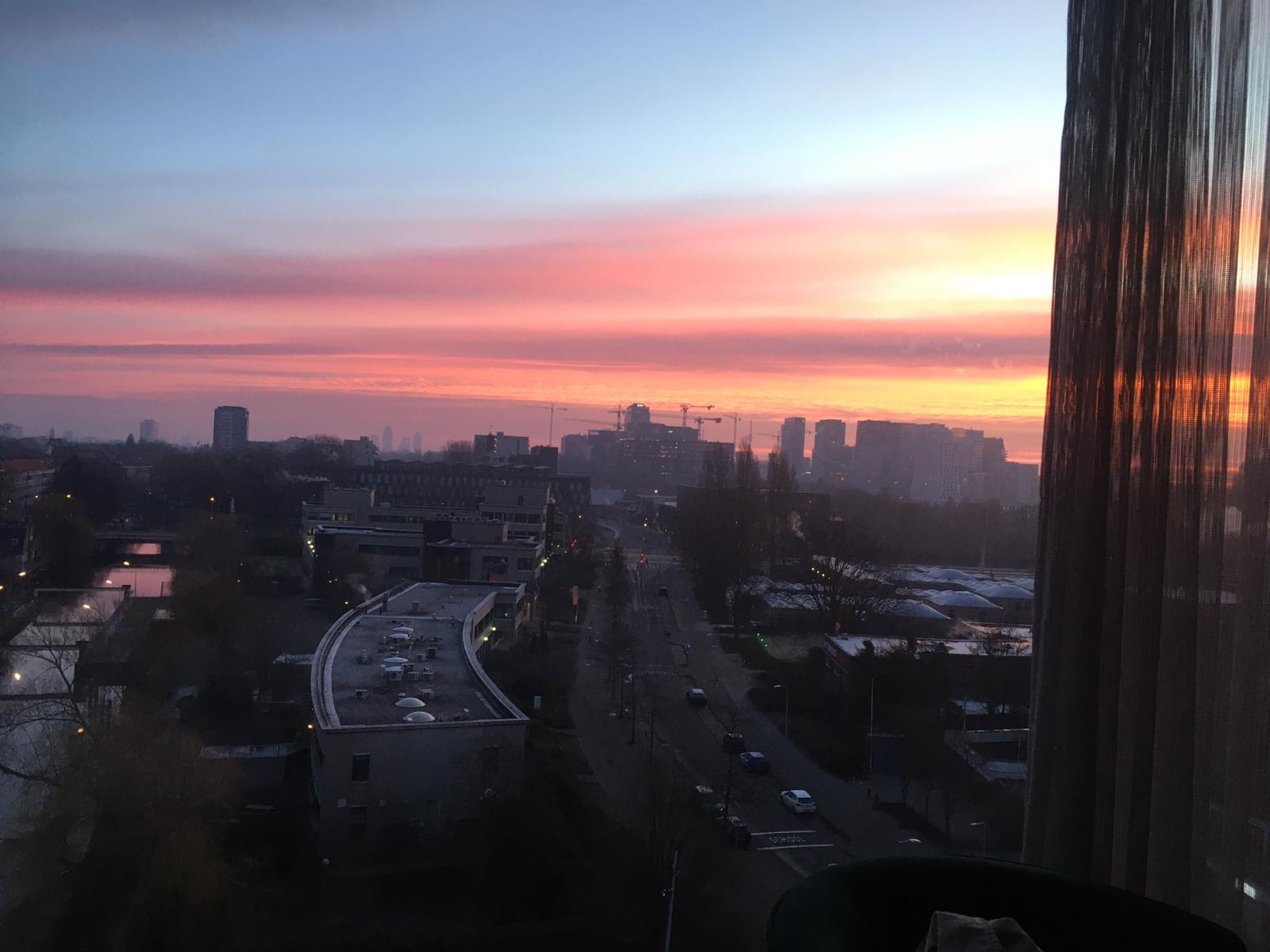
We could play ping pong, or read  newspapers in the”Bistro”  area- where coffee, tea, fruit, infused water and Otis Spunkmeyer cookies are always available (top left). Or read in the library (top right). By now it is 11 am and the mail is only hours away (center).  Flower arranging is possible on Saturday, which essentially is picking up free flowers in the activities room which are donated by Trader Joes (they were going to toss them but gifted them instead).The on-premises bank is available, but we just use it to pilfer the free cookies (bottom left), timing is essential, 


 We are sharing her food plan with monthly points, so strategic planning of meals is required.   The weekly specials are posted beginning on Sunday so  plenty of time to formulate our approach.  Regardless, the food is plentiful and generally tasty with just enough borderline items allowing for hours of post-prandial analysis (“veal scallopini ? more like leather scallopini).


We can stop in at the tavern for a drink (using  free drink coupons won at the twice a month Tuesday Bingo games).  

A different movie is shown (twice) daily, in addition to crafts, we can join into mahjong games, cards/poker, storytelling, puzzles, board games, and drum circles.  A large chicken coop provides free eggs. 


Chickens are all named after famous lesbians. This morning visited by wild turkeys.

Schedule a haircut in the beauty salon, or a massage as the mail is still hours from arriving. Seemingly, almost daily Doctors’ appointments fill our social calendar, otherwise we discuss with our neighbors our chronic aches and our new pains.   Of course, each day is special but some days more so than others. 


The housekeeper comes on Mondays at 1pm sometimes 2 pm, close to the time people start to gather around the mailboxes in anticipation of the mail arriving anywhere between 3-6 pm.  You have to check both the cubbies AND mail box
Hopefully, mail arrives by 4:30 so that we can get to the dining hall for a late dinner.


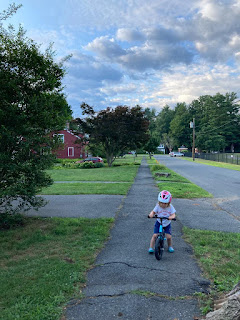
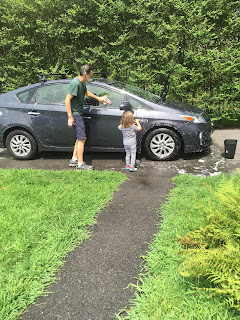
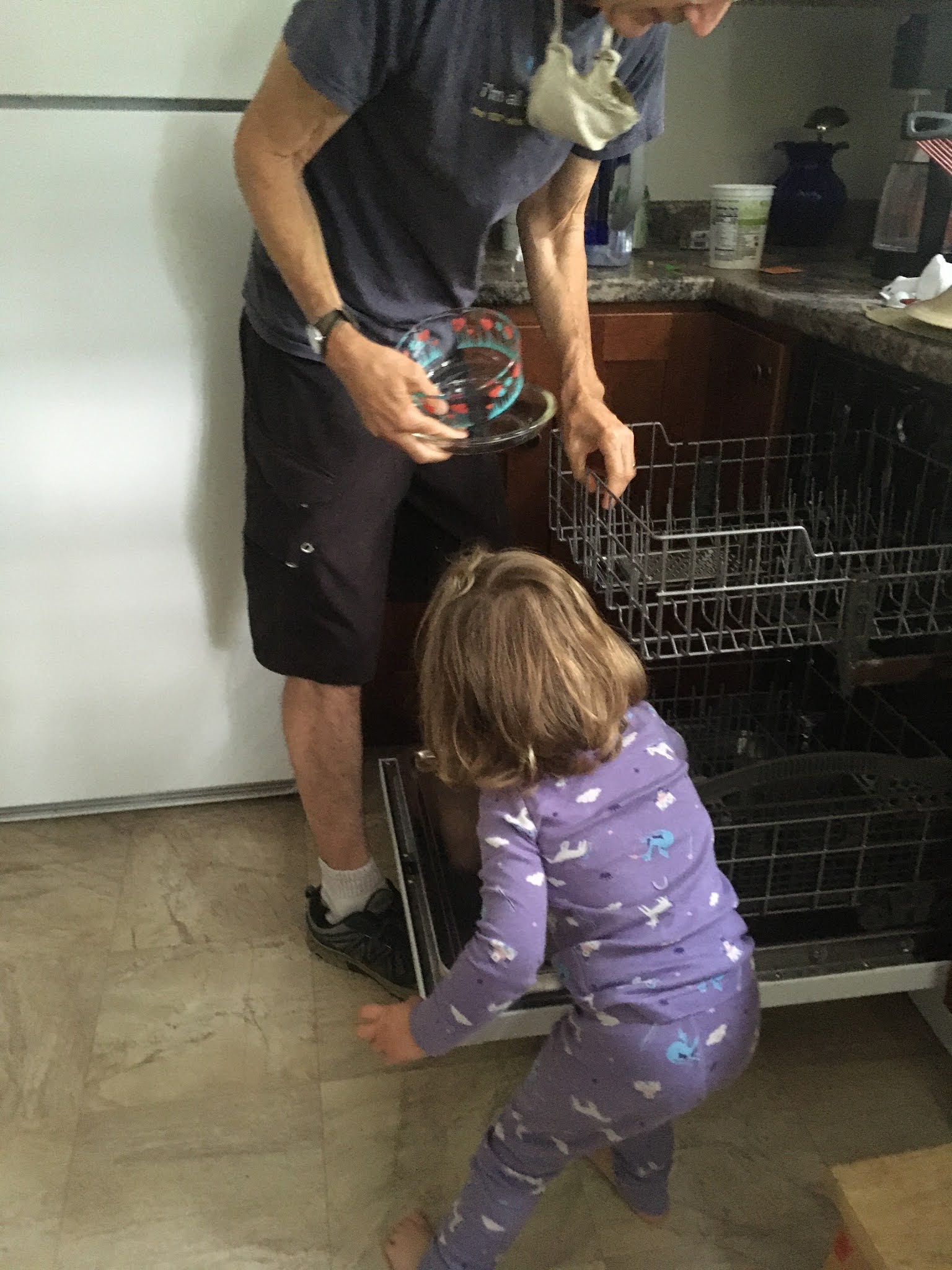
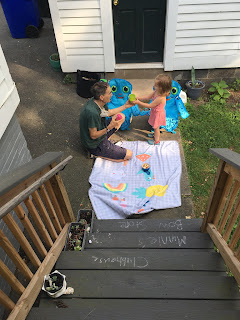
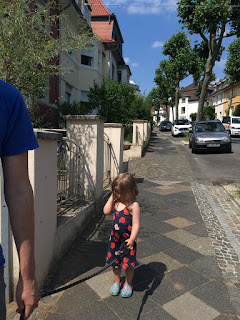
kids came by for a visit

After the mail finally arrives (just junk, as usual) it’s more loud TV, or more recently the gym to exercise to Star Trek reruns (where we ponder deep universal questions like- Is evil present in all galaxies?  Why is Captain Kirk always the only one without a shirt on?  Why do most planets where no man has gone before always look like Chatsworth in the San Fernando Valley?)


The day winds up with a call in to Germany for the daily performance of Grandparent Theater:

Tonight\’s guest stars: Gma, Bert & Ernie

“The Papou and Yaya Show”


Last week: On the Road live from Minneapolis with guest star Simona

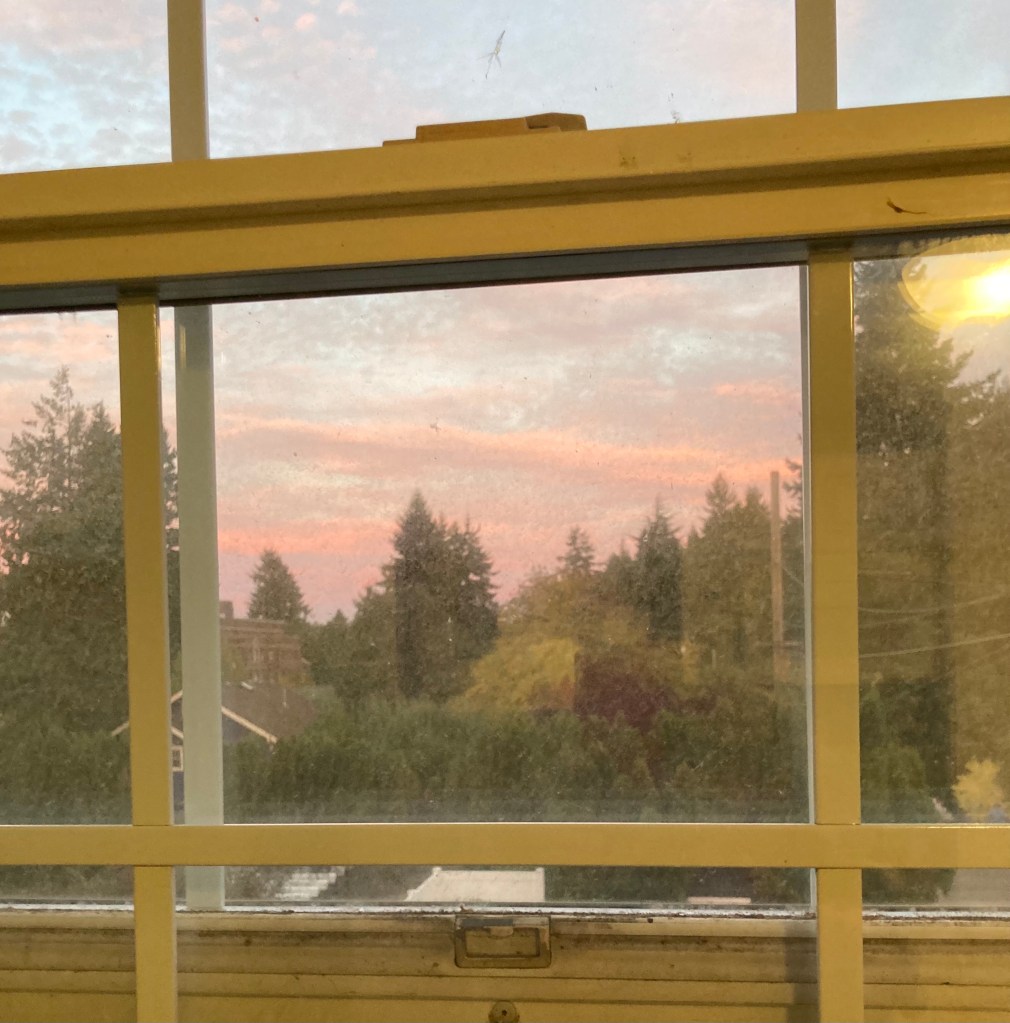
And then we fall asleep listening to the coyotes howling, hooting owls and Wacky Warren next door.   Tomorrow is Wine Wednesday, and per Wild Bill from the second floor we will all wine and whine.

Munich

This post was done prior to a WordPress upgrade, looks kinda bad. Ads make this free but no one benefits.

It is hard not to sound repetitive. Every place (okay, maybe not Ayia Napa, Cyprus) has us saying, this feels better than home.  Pretty much everywhere has felt safer, more livable than the US (gun control, please, please, please). The challenge of each place while  unique,  is usually the history, and unfortunately even that sounds repetitive.  Over and over the past is inequality, capriciousness and persistent cruelty of governments tempered by people\’s perseverance in seeking self-determination and maintaining culture.Germany though has had the highest highs and the lowest lowsWe have loved Germany. It is stupendously beautiful; countryside and cities. Forest, hills, valleys dotted with Fantasyland villages.

Cities are clean, services plentiful, people are courteous, public transportation good.  There are walking trails and pedestrian areas everywhere, forests at the edge (or even center) of almost every city. recycle spots every few blocks.  Food is fresh and reasonably priced.  Nick would move to Freiburg im Breisgau, yesterday. 
https://thechosenfugue.blogspot.com/2019/07/black-forest.html
The country generally is progressive, environmentally conscientious and makes serious attempts at reconciliation with their history. 
Munich was extremely nice, seemed very livable but also underscored the frightening world we currently live in as we examined it\’s not too distant past. 
Like most German cities, there was significant destruction from WWII bombing (Munich was hit particularly hard) so building styles were very inconsistent; old, new and reconstructed. 


Alte Pinoktech Museum, you can see the repaired brick
Like most European cities, Munich had a town square that was anchored by the city hall, the Rathaus, but Munich’s  had an animated clock performing, three times a day,  that attracted a large crowd. 

The inside was as beautiful as the outside,


Inside were also tons of tributes, kind of a city time-line + yearbook going back hundreds of years.


and of course, a cafe in the courtyard.

Around the Rathaus were fountains and statues in the main square (Marienplatz)

and on the streets radiating from the square, beautiful churches with a few different twists (best door knobs ever seen).

Munich had murals and palaces;

and a popular, huge park (English Garden) with a river (Eisbach, side-arm of Isar) where you can surf (with people waiting very patiently for their turn- no supervision, no  cost).  https://www.vice.com/en_us/article/3d9way/welcome-to-munich-the-mecca-of-river-surfing


Rainbow and brown trout


Museums were amazing and varied.   We saw many favorite German artists and were introduced to some new (to us) artists

Georg Baselitz, new favorite
Yes, he painted upside down, well his paintings not him
Design exhibit
At the museum, the historical shadows started creeping in. It was hard to just appreciate the art, in light of the history of Nazis looting art (https://en.wikipedia.org/wiki/Nazi_plunder), we began to feel how that period of time permeates and still resonates.
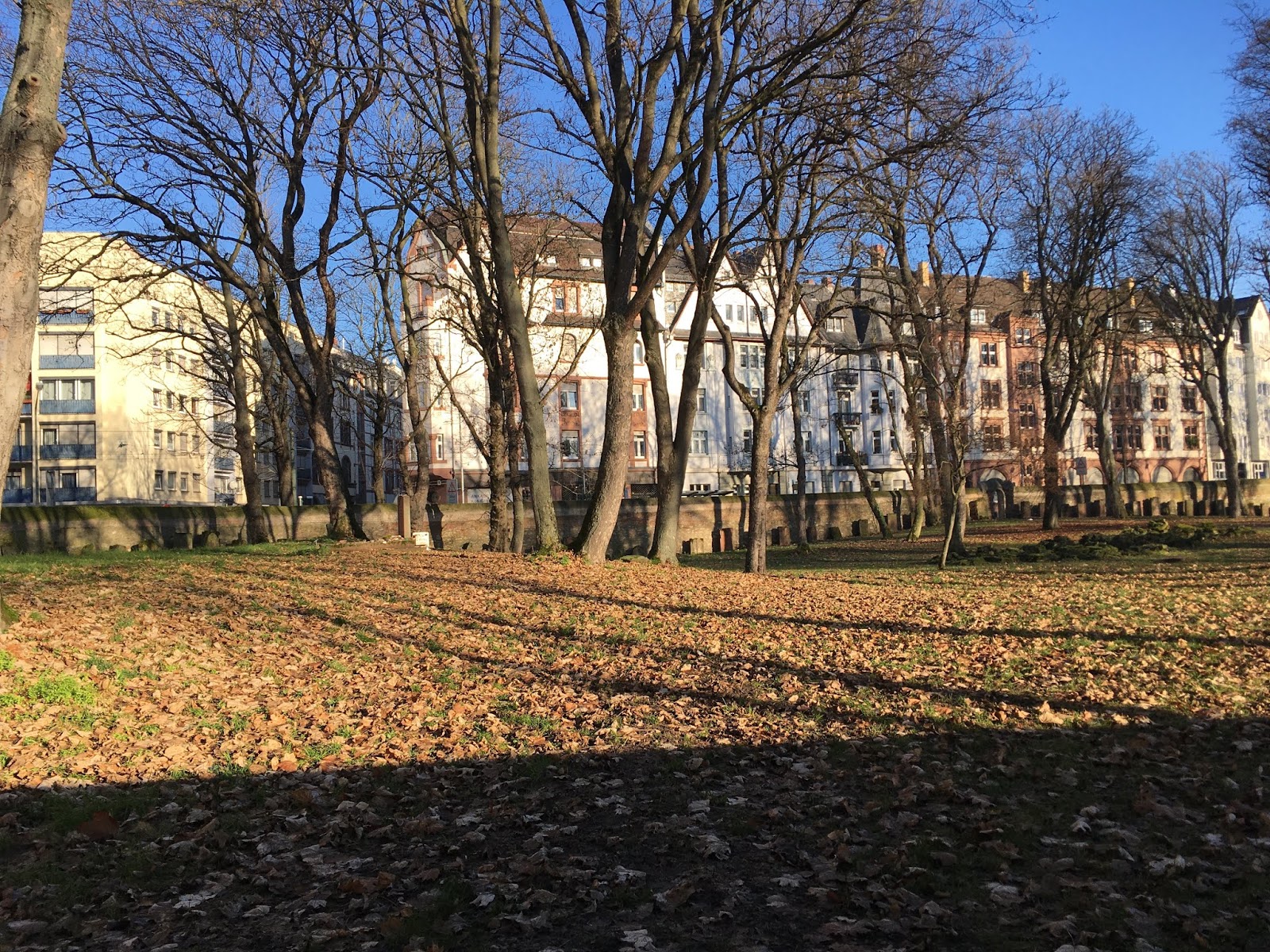
Seen in a Munich park

With the current world situation with so many populist leaders, it was difficult revisiting the origins of the Nazi party at the Munich Documentation Center for the History of National Socialism, opened in 2017 on the footprint of the former Nazi headquarters
(https://www.ns-dokuzentrum-muenchen.de/en/documentation-center/historical-site/ )  The exhibit charted the beginnings of Nazism onwards through today in modern Germany and Europe.  Early Nazi propaganda and practices unfortunately mirrored our current news- it was so disheartening watching history repeat itself countless times as we wandered through Munich\’s monuments and museums. The similarities were so frightening.

Our discomfort wasn’t really with Munich but  as it was the epicenter of Nazism in Germany (as well as the anti-fascist resistance), there were frequent reminders of people\’s cruelty  and how it feels like we’ve learned nothing.
It was encouraging  to see kids  accessing historic sites;  young kids on field trips in the old city center, numerous groups of teenagers in serious sit down talks with teachers around exhibits at the Munich Documentation Center for the History of National Socialism, and at Dachau, and most poignant- a group of physically handicapped young adults, who would not have existed under Hitler,  at the University\’s memorial to the student run White Rose anti-facist movement ( https://en.wikipedia.org/wiki/White_Rose).
In front of the White Rose Museum, flyers embedded in the ground placement as they were when the University students and siblings Hans and Sophie Scholl threw them as they were arrested and then executed in 1943

Dachau was vast. It was unimaginable to think how many lives it once contained, controlled and eliminated. They said the biggest problem was overcrowding yet the space was massive and to realize it wasn’t big enough for the volume of lives that were abused and lost, devastating.

Unfathomable just considering the uncertainty experienced by the prisoners, especially with death everywhere. The barracks, the claustrophobic cells, the horrifying crematories but nothing more frightening than the open space, imagined crammed with people awaiting the worst.
Described by a survivor, the 2 mile walk  from the Dachau train station to the camp, was punctuated by the incongruity; through picturesque forest and natural beauty to the ghastly and dehumanizing destination. path remembrance Dachau
Although we all are familiar with the horrors of the concentration camps, being there just emphasized that, from our frame of reference, we can never really be familiar, never can completely comprehend the experience and inhumanity.
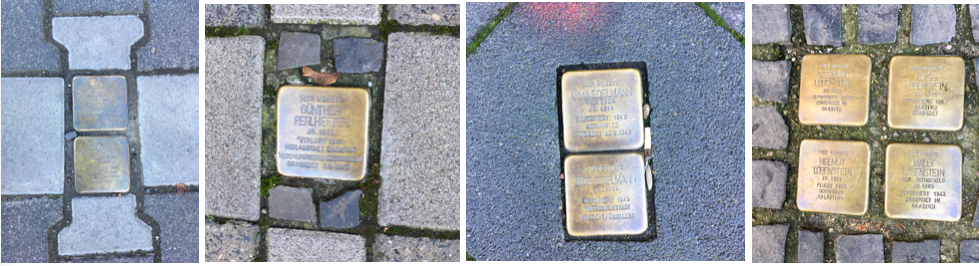
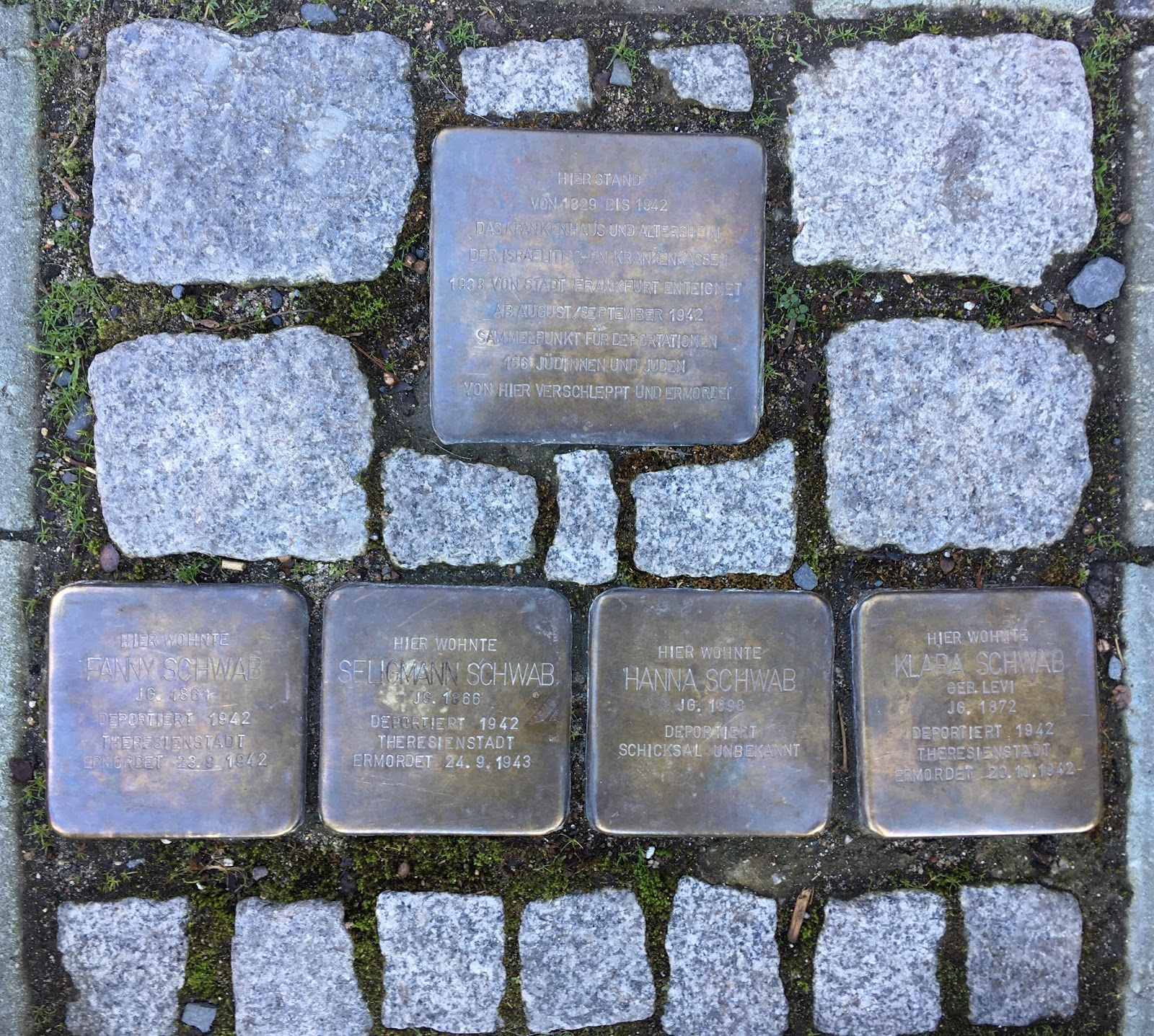
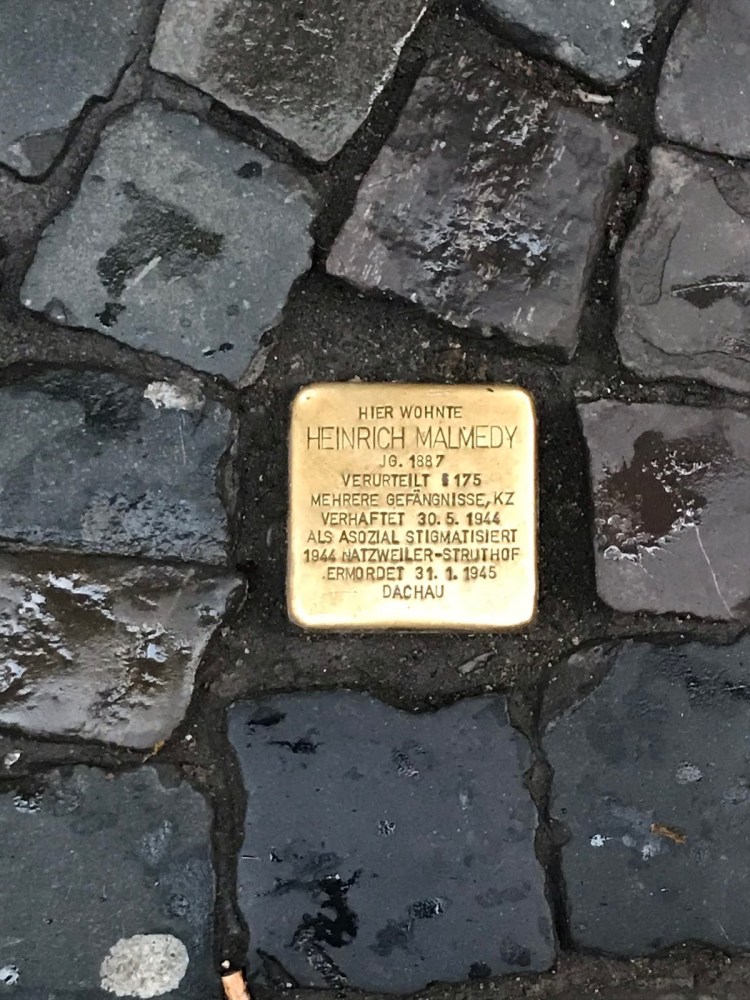
Stopelsteine in Dachau, the city, about  a mile from the camp
Dachau, about 10 miles north of Munich, was the first concentration camp.  It opened in 1933, and was actually used initially for political prisoners (anti-fascists, communists, partisans from invaded countries), which ultimately was anyone opposed to the new Nazi government including clergy, as well as “undesirables” such as Sinta/Roma, homosexuals, Jews, mentally and physically handicapped.  Initially, the camp also supplied needed labor for the country.  Jewish prisoners weren’t really the majority until the late 30’s.Both Dachau and the Documentation Center admirably emphasized the absolute lack of individual accountability for the majority of Germans- soldiers, politicians, civilians.  And that was the challenge of Munich, it was where the Nazis got their start and power but how does a city acknowledge and repent?   Part of the problem is many of the buildings used by the Nazis were destroyed in the war and identifying those sites or existing buildings for educational purposes has been controversial.   Munich is stuck between pointing out Nazi sites while preventing Neo-Nazis from congregating and revering them.

The 1844 memorial to fallen German soldiers became a Nazi icon since it was  the site of the Beer hall Putsch, when Hitler tried to take power in 1923.  Munich has had to balance preserving this monument and preventing Neo-nazis from celebrating it. During the Third Reich, anti-fascist Germans would walk behind it so they would not have to salute it as required by law (alley is called Shirker’s Alley)
In front of a store, not on the street
Munich continues to struggle with competing groups; those wanting to diminish or or rewrite history,  those wanting to just move on and those wanting more public accountability. This is exemplified by Munich\’s  lack of  Stolpersteine. https://thechosenfugue.blogspot.com/2019/01/they-do-make-you-stumble.html The city banned them, only allowing them on private property. Munich’s Jewish community president was not supportive of them although the German Council of Jews and many other local Jews and  Germans were.  Munich’s alternative, started in 2015, were 5×5 plaques (not much different then an address nameplate) somewhere on or near the house but when we went to find some, it was difficult and we couldn’t. About 50 exist, and as with the Stolpersteine, memorializing not just Jews but all victims- people with mental illness, physically disabled, Sinti/Roma, gay, Jehovah’s Witness and the resistance.  In contrast to the Munich ones, the Stolpersteine seem to more accurately reflect the proportionality of the groups victimized.
(https://www.muenchen.de/rathaus/Stadtverwaltung/Direktorium/Stadtarchiv/Erinnerungszeichen/Biografien.html.
Each day after being  overwhelmed by the contradictions of history and present day, we returned to be rejuvenated by our hotel in the very ethnically diverse upbeat Little Istanbul area of Munich, very much appreciating our Turkish/German hybrid Hotel Goethe and the surrounding neighborhood.

So, Munich kind of encapsulates our (thus far) European experience; contemplating it\’s  tragic and violent history against the backdrop of wondrous natural beauty, inspiring art and and persistent resistance, unfortunately often futile.
We’ll continue to try to ride the wave of optimism.


Black Forest

(this post was in the older format, sorry it looks really bad!)
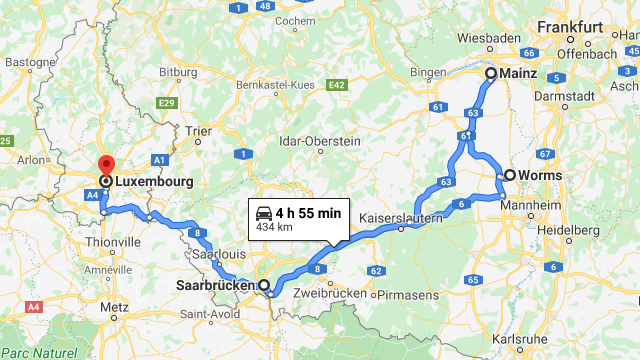
Back to our home away from home, Saarbrucken, to spend a week with A, W, I and Finn and then a week dog-sitting Finn while they went off to a conference in Greece.
 

After a grueling week of dog-sitting, we needed to escape  hoping to see the forest for the trees. We set off for our long-anticipated trip to the the Black Forest,  ready to make use of the Konus card, which is a great idea to encourage tourists to forego cars. For most of the cities in the area, you get a card for free transport on all buses and trains the day you leave. So we planned our stops around getting the Konus cards and riding the two most famous Black Forest train routes, -Schwarzwaldbahn and Hollentalbahn. The Black Forest, which is named for the density of trees and not our moods, is composed mainly of Norway spruce and Scots pine.  From our California-centric, with a touch of Oregon, eyes, the area looked like if Western Oregon, Tahoe and Central California (throuple?) had a baby.  The view alternated between rolling green hills, farmland and dense forests filled with spindly tree trunks topped with Christmas tree crown. 

 
Known for its hiking/biking trails,  cuckoo clocks, and black forest cherry chocolate cake. We sampled none of these, staying consistent with our travel philosophy.  We kept our walking within city limits, which did include a few forest paths, and somehow saw only a few clocks and cakes. We did see a lot of hikers and bikers and mostly kids on field trips.  One inspired group of young adults was already drinking beers on the bus at 9 am on their way to Titisee.
 
On the train/bus rides, at times, we could not see the forest for the trees because there were lots of tunnels, the darkness alternating with forest, farmland and quaint towns full of half-timber land ornately decorated buildings (must look like perfect snow globe towns in the wintertime)  We visited 4 of these towns in the area, Gengenbach, Donaueschingen, Titisee and Freiburg ending up in Zurich, Switzerland.
 
Walking into Gengenbach  felt like walking into a postcard.

It is known for its town hall becoming a giant advent calendar in December with each window opening to a new nativity scene for 24 days. 

taken from German travel site

Since it was July, we settled for watching the stork nest and college kids downing 24 river-chilled beers.


Case of beer midstream
Donaueschingen is famous for being the source of the Danube River (Donauquelle).

This in not without controversy as the Danube is formed by the confluence of two streams the Brigach and the Breg.  So hydrologically speaking (which we never have, except a few words), the source of the Danube is the source of the Breg which arises near Furtwangen.  This was a source of dispute for 30 years between the two towns until the state government granted Donaueschingen to be the Donauquelle.  Essentially saying “Damn you Furtwangen”!  Pardon my hydrologic.
Anyway we saw the spring that claims to be the origin and its fancy monument where everyone takes selfies,


then we walked to where the spring empties into the Brigach stream at the temple of the Danube 90 meters from the source.

and finally we walked through the Furstenberg park to the confluence of the two rivers, more exciting but less photogenic,

Breg on left and Brigach on the right combine to create the Danube under the bridge

Now we have seen the start, roughly the middle (https://thechosenfugue.blogspot.com/2019/07/the-budapest-marathon.html and end of the Danube (https://thechosenfugue.blogspot.com/2019/06/delta-takes-flight.html).

Donaueschingen was a draw though even without it’s claim to fame as the birthplace of the Danube. It was the hardest German city name to pronounce for us, had nice public art and buildings


It is the home of Furstenberg brewery (beer not very good) and the home of the Furstenberg family whose lands make up the huge city park.
Roman goddess Diana in front of the Furstenberg Hotel (so yes, now combines to form a Diane von Furstenburg moment, actually she did marry into this family, her wrap dresses much better then the beer)
City mini-golf -beergarden in the Furstenberg park

We stayed in a hotel that really tried to match the ambiance of the city with gummy bears on the sheets and an incongruent Japanese inspired bridge to nowhere

 
Titisee (sadly, not pronounced as it looks) was a quick one hour stop to peek at the touristy town and the lake.  We declined the rundfahrt (watch it, its just German for tour, we love German).


Freiburg im Breisgau was the highlight of our Black Forest Rundfahrt.  Right away, we loved it and wanted to move there.  A college town known for its emphasis on environmental sustainability. We immediately fell into a climate change protest march and were invited to join in.  


The college, located in the beautiful old town area was vibrant and hippy-esque, kinda felt like Berkeley.

The center piece of the town was the majestic Cathedral which also happen to have a wonderful diverse, popular farmer’s market occurring in the surrounding square.    

 
they even had a marbles stand

Just total good vibes and while it had everything a good German town has, it had it in troves

beautiful Starbucks buildings
 
uniquely German stores
River Dreisam through town, not sure why it was red
Geranium filled window boxes on beautiful buildings
Memorial to destroyed synagogues-a fountain placed in the footprint of the synagogue destroyed on Kristallnacht
(very striking )
Stolpersteine every few feet throughout the city
(https://thechosenfugue.blogspot.com/2019/01/they-do-make-you-stumble.html )

Freiburg had it\’s own quirky  twistslittle streams flowing through gutters called Bachle used for cooling and fun, small wooden boats for sale throughout town ( special editions issued each year),


street cobblestone mosaics identifying a type of store or honoring someone/something (sister city)


Summer carnival in front of the church.
 

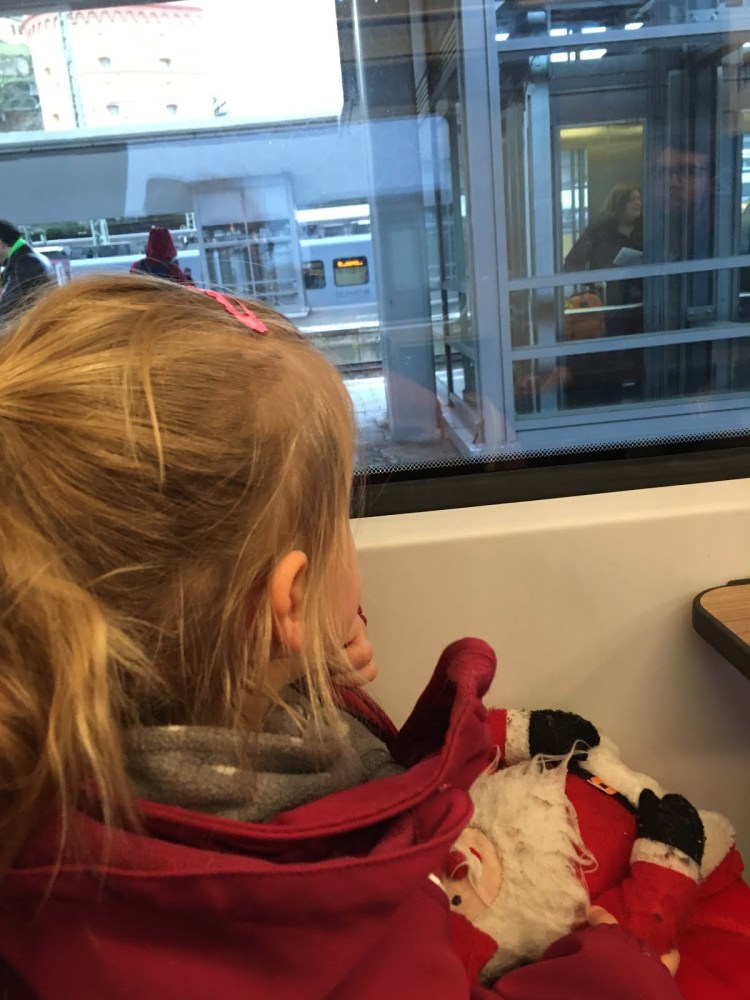
We wrapped up our blitz through the forest in Zurich to meet up with A, W and I plus Finn for two days although most of it was spent hanging in the hotel room with a feverish pink-eyed little girl. But thankfully we had a window that overlooked the train station for some pretty exciting afternoons  

Can”t say much about Zurich since our walkabout was limited to a few streets but it was pleasant and rather neutral, just like Switzerland
 

 but we did get to meet a unicorn. 

Zurich 7/22/19. Swiss Cheese shirt fulfills it’s dream of seeing Switzerland before it expires. RIP

This week’s photo of topless old man looking out window contemplating his life…Robe time, so move along, nothing to Titisee here


The Budapest Marathon

Last minute stop in Budapest as we traveled from Romania back to Germany.
Typically, we are able to speed see all a city’s sites in a day or so as they are often within blocks of the town square where we try to stay. Considering we don’t shop and rarely restaurant, this is not usually a problembut our sprinter mentality failed us here due to the sprawl of Budapest.   Our day and a half in Budapest was a long distance affair as we walked a marathon plus (12.5 miles the first day and 14.3 the second). 

Most of the famous landmarks are on the Pest side where we stayed, and we saw them all, even Ronald Reagan.

We went for the big ones and along the way saw the small ones. The biggest was the Parliament, so big it needed a bunch of pictures (with Nick included for comparison)

Kossuth square in front of the Parliament was the main site for Hungary’s attempt at revolution in 1956.  Equally bloody as Romania’s (2500 died), but ultimately (after 19 days) unsuccessful.   https://chosenfugue.wordpress.com/2019/07/12/timisoara-the-revolution-will-not-be-televised/

Hungary had to wait another 33 years before the removal of its totalitarian government, although unfortunately it seems to be back again. Their memorial museum was built in tunnels beneath Kossuth square, the square where the worse violence occurred. Here we were again, within our first few miles of walking through Budapest, seeing the bullet holes, visiting the memorial museums, contemplating how governments can attack their own people and feeling the futility.  

As also seen in Romania, some of the memorials are truly heart felt, many are overwhelming. Shoes on the Danube, another memorial to people murdered by their own military. https://en.wikipedia.org/wiki/Shoes_on_the_Danube_Bank

Shoes Along the Danube, a memorial to Jews killed by the Hungarian Arrow Cross militia between 1944-45. 
People were shot on the edge of Danube,  to fall in and  be washed away

To provide a contrast to the Shoes on the Danube memorial to people killed by their own government just solely for existing, in 2014 the new Far Right government tried to add to the Budapest travelers “must see list” with it’s own monument to “victims of the German Occupation”. Unfortunately, the victim in this case (Hungary) was one of the perpetrators of the “occupation” since they invited Germany in and willingly implemented their policies (see the Shoes on the Danube above).  Despite rather large and loud protests from their people, the government installed the monument in the middle of the night.  

The Hungarians, again, decided to take things into their own hands, and a spontaneous memorial to the actual victims of the German occupation- Jews, Roma, Catholics, gays, disabled and anti-fascists- was created, right in front of the Government’s atrocity.   The memorial contained personal stories and possessions placed by survivors and victim’s families and friends; sprinkled with rocks- left by people paying their respects. 

As with other DYI memorials, this one was incredibly touching, one of the most impactful memorials we have experienced, it was not just seen, it was experienced. 
Because of these two polarizing memorials, Liberty Square, which also contains the Reagan statue, is the most police-protected spot in Budapest. 

Budapest seems to do everything big; monuments and beautiful buildings. Since Budapest was a center of the Austro-Hungarian empire, there were a lot of beautiful buildings and monuments to the empire’s history. The monuments all seemed to be named after Budapest streets.

Unlike many other European cities of similar vintage, Budapest is not an old walled city but around mile 20 we did hit the (proverbial and literal) wall when we tried to visit the famous Szechenyi public baths in the massive City Park.  We thought the baths were open-air allowing us see them without going in, but it was completely enclosed in a lovely building.  We were able to partially peek thru a window, but weren’t terribly interested in sitting in hot water anyway as it was 90 plus degrees out, not appealing.  

Also in the City park with  Vajdahunyad castle, built in 1896 to celebrate 1000 years since the Hungarian conquest of the Carpathian basin. The castle was built out of cardboard and wood to showcase Hungarian castles built in different styles- Romanesque, Gothic, Renaissance, and Baroque. It became so popular that it was rebuilt from stone and brick between 1904 and 1908.

By the end of the marathon everyone’s legs felt like stone

After we hit the main sights during the day,  we uncharacteristically ventured out at night. First stop was the former Jewish quarter, and it  was truly a quarter as  25% of Budapest was Jewish (in early1900’s Budapest was nicknamed Judapest). It is now reformed as block after block of “ruin” bars, hip clubs and bars filled with hen and stag parties on weekends.

Considering Budapest’s  history of a large Jewish population plus the miles covered it was not surprising to have added to the Stolpersteines we have stumbled upon https://chosenfugue.wordpress.com/2019/01/07/they-do-make-you-stumble/

We just kept walking,

crossing the bridge from Pest and ending the night in Buda. 

Looking south, Buda on the right, Pest on the left

It was easy to feel very old world leaving our Air BnB

riding away from our Budapest Marathon.

Timisoara, the Revolution will not be televised

Out of Transylvania on to  our last stop Timisoara in the Banat, another area in Romania ( like most of European History) with a succession of rulers and mix of cultures this time with a bit more Hungarian and Serbian tossed in.  

What drew us to Timisoara was that this was where the 1989 Revolution began and we were curious to learn more.  The Romanian Revolution of 1989 was part of a wave of  change culminating in the end of communist control in Central and Eastern Europe. The economically weakened USSR lead by the fairly tolerant Soviet leader Gorbachov combined with civil unrest and union strikes provided the catalyst for a dismantling of the soviet block. The domino effect began in Poland with Lech Walesa\’s Solidarity party gaining control of the government in June 1989. The success in Poland was followed by Hungary, East Germany (Berlin Wall came down November 9.1989),  Bulgaria, Czechoslovakia and finally, Romania.   Only Romania’s overthrow was violent bloody and deadly.  So, after almost a year of travel with constant reminders of our historical ignorance, we decided to seize the opportunity to learn more about the Romanian revolution in Timisoara, the city where it began.

Our education regarding the revolution began with a visit to a very heart-felt museum. Exhibits looked like a tragic 5th grade science fair with homemade posters- black & white photographs glued onto cardboard, hand written descriptions and red embossed labels.

There was such an immediacy; it was raw emotion.  Family photos of dead loved ones (as young as one month old).  Blood stained clothes. Clothes with bullet holes.  

Along with the immensely personal exhibits, there was a 30 minute (VHS ?) documentary of the rebellion in Timisoara.   

And, to place these events of 1989 in the context of world history, a timeline covered the previous 100 years-WW1, WW2, moon landing, rebellions in other Eastern Block countries, etc was presented in posters lining the hallway.

Clear in these pictures is the decay and condition of the building.  It was hard not to compare to museums with remarkable architecture and appropriate maintenance that did not have half of the emotional impact this museum did. 

The revolution began on December 16 1989 innocently enough with a public protest in support of an outspoken Hungarian pastor, Laszlo Tokes, whom the government wanted to evict  from his church.  Parishioners gathered around his home to try to protect him and his family from eviction.

Passerby joined in and by evening the growing crowd started chanting anti-communist slogans including “down with Ceausecu\”.  The next day, this organic uprising resulted in almost the entire town protesting in the main squares.  The military was called in.  Word of mouth spread the unrest to other cities (all media was controlled by the government and phone lines had been blocked coming out of Timisoara) and by December 21, 1989  the protests erupted in almost every city in Romania. with unrest spreading throughout the country.


Ceausecu tried to squelch the uprising with a speech from the Palace Square in Bucharest- promising an increase in the minimum wage. But, the crowd of over 100,000 quickly turned against him chanting \”Ti-mi-soa-ra\”, \”down with Ceausecu\”.  
(watch the very short video here where he realizes the crowd is against him, for the very first time and very last time https://deadstate.org/watch-the-exact-moment-when-a-brutal-dictator-realizes-the-crowd-has-turned-against-him/ )

Rioting disrupted his speech requiring he and his wife, Elena, to escape by helicopter. They were both caught the next day arrested, tried and shot dead by a firing squad on Christmas Day just 10 days after the initial events in Timisoara.  And, communist control of Romania was over, but with a heavy toll, close to 2000 died, thousands injured during the protests and the confusion following the fall of the government.  Discussion with the museum curator (very intimate museum) who was 20 at the time of the uprising and living in Timisoara, said she didn’t believe it was really happening. Mass confusion and fear prevailed, there was no media (tv completely blocked), everyone relied on word of mouth, rumors were rampant no one was sure who to trust (with good reason). And when the end did come, no one could believe it was really Ceausecu who was killed.  Later we walked the sites to Pastor Tokes building and church, to the main squares where the riots and killings took place, now looking very different but with bullet holes remaining in the buildings.   


Walking anywhere in the city, we saw the many memorials to all the martyrs/heroes of the day 

At the cemetery commemorating those who died and were buried and those whose bodies were never recovered (burned by the government in a rushed attempt to cover up the rebellion).  Feeling of sadness and anger remained.

We looked back at our visit to Bucharest to try and recreate the events there and picture Ceaucescu on the balcony of the enormous Palace surrounded by a huge square filled with thousands of angry disillusioned citizens ready to revolt. https://thechosenfugue.blogspot.com/2019/07/bucaresti.html

Timisoara, beyond it’s role in the revolution, was great in it’s own right.  It checked off all the boxes expected of a historic-Ottomon-Habsburg-Austo-Hungarian European mid-sized city. 

 park lined River (Bega)
Beautiful buildings
Empty synagogues

But there was a different vibe here. Like most European cities- history was celebrated and on display  but in Timisoara it was with a slightly different more non-traditional approach, it felt like it was moving on and looking to recreate itself, like it probably has done many times before.
A Cheers bar-gotta start somewhere
Church with an attached cafe, Our Lady of Perpetual Mimosas (?)
Empty synagogue looking to now be a restaurant
Thoughtful graffiti
Luring travelers with the iconic shot for every travel photo blog or an homage to winter in Eugene

We toasted Timisoara, Romania and the revolution with local craft beers at a Bar with the Museum of the Communist Consumer in it’s basement, kind of a History within a Hipster Bar/ DIY museum.  (much better than the Cheers bar)


This week’s picture of topless old man looking out window contemplating his life…Perfect family vacation

A Taste of Three Transylvania Towns

It’s understandable that vampires have chosen to spend their eternal lives in Transylvania, as it is one of the most beautiful areas (countryside and cities) we have visited.  While our visit to Transylvania was short-lived it definitely got in our blood.

Our first stop, Brasov, had it’s own “Hollywood sign”, and deservedly so, as it looked like a movie set, the picture perfect walled old city.  

The iconic centerpiece of the town is  St Mary’s church  nicknamed the Black Church, although it is gray, due to discoloration from a fire in 1689 during the Great Turkish War. 


The walls included seven towers and gates, and as was customary at the time, each was built, guarded and maintained by different guilds-Tanner’s, Draper’s, Weavers etc. 

The wall with two of the towers just below the hill

One tower is called the Black Tower, which is actually white.  So, Brasov apparently is colorblind as a bat.  The walled city was impressive, but like every walled city we’ve visited, so much effort to build but doesn\’t work as we easily got in.
Due to its location, Transylvania’s convoluted heritage includes Romanian, German (Saxon), Hungarian and even some Bulgarian roots which maybe explains our airbnb’s incongruent name, 
The Roberta Long Suite.  This history has led to a distinct blend of architecture and culture.  
We knew that all of the buildings were special as almost every single building had a historic marker, although the marker did not identify what the building was, it\’s age or why it was significant.


Brasov’s location was also a perfect base for traveling in the area so we took a day trip to Sighisoara.  
It was very enjoyable despite some record heat and humidity.   It felt like the sun was always directly over our head because we never saw our shadows (!). It was a smaller, less well maintained version of Brasov, with some unique  attractions including the birthplace of the gruesome and real Dracula (Vlad the Impaler)  which was an interesting contrast to our visit to Whitby, England where the writer Bram Stoker was inspired to create the gothic and romanticized Dracula. (https://thechosenfugue.blogspot.com/2018/10/scarborough-fair-moor-or-less.html).  
Dracula\’s house and neighborhood 
The famous hilltop Dracula\’s castle (Bran Castle), another major tourist highlight is located in Bran about 15 miles southwest (as the bat flies) of Brasov.  We didn’t go. 
The train ride through the Carpathian foothills between Brasov and Sighisoara was very pleasant.
In Sibiu we serendipitously stumbled on the last two nights of a crazy 10 day international theater festival.  Each evening there were open air performances in the exquisitely charming squares and malls which were packed with people and ice cream stands. 
French marching bands with bagpipes, Italian faux-military bands, and Spanish samba dancers dancing with Dundu the giant of light from Germany. Stilts were well-represented by giant glowing chameleons from Germany and waltzing dancers from Italy. 


The finale from Italy was a hyper Thanksgiving Day like parade of balloons and music celebrating Leonardo Da Vinci, capped off with  fireworks to end the festival.

These were our first  stay-out-very-late nights, but of course, in Transylvania we should have realized the party doesn’t get started until after the sun goes down.

In addition to the festival, there was Sibiu itself.

There was so much to see that it is understandable that the houses of Sibiu have eyes, and wanted to watch as well.

The joke used to be it was Communist Dictator Ceausescu spying on everyone.

We made a last minute stop at the local blood bank and then off to our final Romanian destination.

This week\’s photo of topless old man looking out window contemplating his life…Doubleheader

Bucaresti

(this was in the old word-press format, sorry it looks pretty bad)

We headed out of Tulcea to Bucharest on what we thought would be an uneventful 5 hour mini-bus ride.  However, we were soon fascinated by the local life.  The main road initially paralleled the Danube and it was dotted with fisherman standing by the side of the road like hitchhikers (fishikers?). No they were not looking to carpool, rather they were dangling fresh fish for sale from their fish filled  styrofoam coolers or trunks of their cars.  The type of fish they were selling roadside?  Our guess was turn-pike.
Prior to our visit, everything we read about Bucharest was rather dismissive, recommending just a half day visit would suffice. Compared to what we read, our experience was very different. We spent 2 days, and wished we had stayed longer especially after learning more about the Romanian Revolution of 1989.  Bucharest was simultaneously beautiful, ugly, downtrodden, inspiring and frightening.

We were initially amused by the items found in our airbnb but it really foreshadowed what we would later learn and helped us to better understand Bucharest and Romania under the dictator Ceausescu and the struggles to a more Western economy post 1989 revolution.
A flute? Celebrating the folk art history of Romania. We didn’t play it. Shirts for sale in the refrigerator closet? Romania transitioning to the market economy and capitalism. We didn\’t buy either.
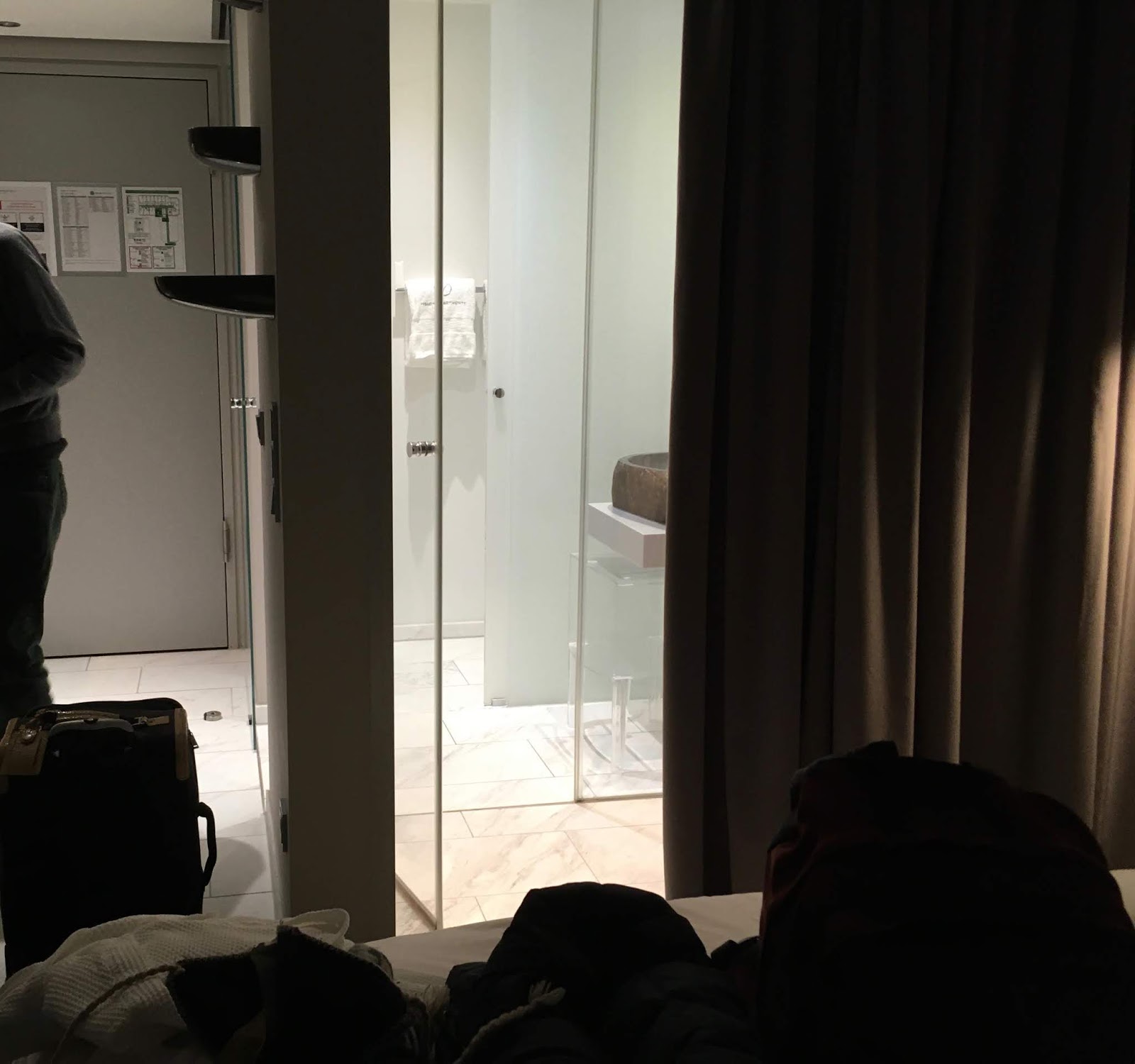
See-thru bathroom inside and out-reflecting Communist Romania\’s history of extensive civilian spying.  We showered in the dark (actually the shades did go down).
Hybridized architecture, buildings in flux, in need of renovation. We admired the building while avoiding construction debris in the stairwell up to our flat.
Bucharest, like so many of the cities with beautiful, massive buildings, benefited from the building boom initiated in the mid 1800s  by  the Austria-Hungarian Empire (which was kind of a continuation of the Hapsburg Monarchy which was kind of a continuation of the Roman Empire).  When Romania became it’s own country in 1918, it wanted to create a magnificent European capital to house it’s growing population (population had tripled) resulting in a city with a mishmash of  old buildings of baroque, art nouveau, secessionist and quasi-byzantine styles. 
 
Seems like a lot of the renovated buildings now house a bank, Starbucks or a McDonald\’s
 
After WW2, and the rise of communist government, the type of buildings changed dramatically as a weird hybrid was created with classic features (columns, porticos)  integrated into 3-4 story brick buildings built around courtyards to house the people rushing into Bucharest from the countryside (where in 1948 80% had no electricity or running waters in their homes)
In 1965, Nicolae Ceausescu came to power and he had his own ideas about what a city should look like- essentially no green, just massive, concrete and crowded- kind of like commercial chicken coops for people.  
More 80\’s music love


Ceausescu was initially popular both at home and in the West as he challenged Soviet authority by ending Romania’s active participation in the Warsaw Pact, refusing to take part in the 1968 invasion of Czechoslovakia, and easing press censorship.  Romania was one of the few Communist countries to participate in the 1984 Summer Olympics in Los Angeles when most of the Eastern bloc countries boycotted the event.
However, after a visit to North Korea and China in 1971 when he saw how their leaders, Kim Il-sung and Mao, used  totalitarian rule he became obsessed with creating a similar situation in Romania.   He returned and began similar control of all branches of the government and the citizens
Control of the media, ubiquitous secret police spying on civilians,  pro-Ceausecu propaganda plus his megalomania effectively destroyed Romania.
Ceausescu , inspired by how Kim designed PyongYang became  very involved in urban planning and a devastating earthquake in 1977 provided an excuse for him to destroy a large portion of the historic city center to build his dream (or nightmare);  The People\’s Palace,  the heaviest building in the world,
with surrounding grandiose apartments, promenade culminating in an extravaganza of fountains (Bulgarians must envy).   
 
He bulldozed one fifth of the old city displacing 50,000 people. (A side note is that he made many dogs homeless which caused a dangerous feral dog problem that lasted for many years).  
In 2019, the city’s buildings are both falling apart and being restored; some effectively combine old and new, 
while others just sit sadly, such a waste but clearly not a priority in a poor country with many needs.
 
Despite years of communism and neglect,  many churches survived and are pretty much everywhere you look. 
Thirty years after communism, Romania is still experiencing growing pains.  
Governments subsequent to the revolution are still trying to find their place in the world.  Like Bulgaria, like Serbia, like Croatia, like Cyprus these countries  still need to address the cumulative sins of the last thirty years (corruption, genocide) in order to join the Schengen area of greater Europe.
Memorial to those killed in 1989 Rebellion, often referred to as the toothpick with the olive
 

Delta takes flight

Our stop in Constanta,  Romania was just like a ship passing in the night since we just stayed about 14 hours as we were catching an early train to Tulcea, Romania    Our exposure to the town limited to walking along the  same 2.9 km between the  bus/train station and our place. We had enough time to learn that the town really seemed to like The Hobbit and Lord of the Rings as these were everywhere. (toilekan=Tokien in Romanian?

The train left the city passing seemingly endless fields of wheat and sunflowers. Romania is still a primarily agrarian country with 45% of the population living in rural areas.  We also saw lots of herds of sheep, cows and goats with everyone having an actual shepherd and dog overseeing the flock.

Our visit to Tulcea, the entrance to the Danube Delta,  was first a “oh, maybe we should go there” which quickly transformed into a highly anticipated stop  s we read more and more about it. Black to Black: The Danube River, Europe’s second longest river (after the Volga), begins in the Black Forest , flowing south east for 1770 miles  through 10 countries (more than any other river in the world) before ending at the Black Sea in northern Romania into a complex extensive Delta.

The Delta is a huge wetland, minimally developed, with three main water channels and a marshy forest (Letea).  Over 350 species of birds live here, some year round, others migrate through.  An unexpected pleasure during the year of traveling has been seeing wild birds. Birds seen from trains, buses and when walking through fields and parks and along rivers and seashores. Flushing pheasants and quail in UK https://chosenfugue.wordpress.com/2018/10/27/scarborough-fair-moor-or-less/,  surprising a bunch of guinea fowl in Cyprus, https://chosenfugue.wordpress.com/2019/01/27/paphos-the-redemption-of-cyprus/ observing flamingos in salt water lakes of Cyprus, bonding with seagulls in Burgas, passing wild turkeys in Santa Rosa and watching the distinct Saar pigeons on a square in Saarbrucken.  In Bulgaria and Romania we have been seeing storks (and stork nests)  through bus and train windows. 

Most of the bird  encounters have been serendipitous, but this time we were going on guided tour in a boat! So we were pretty excited. Our Delta tour began at a little after 6 am (Delta Dawn) with just us and our guide Carmen, who learned English from watching Cartoon Network, with his favorite show being Yogi Bear.  He was very animated.

Pictures do not do justice to the serenity and beauty.  We were able to see kingfisher, ibis, pelicans, mute swans (with babies), ducks, 4 species of herons, 2 species of cormorants, spoonbill, egrets, and an eagle.  This picture, which kind of looks fake but isn’t,  has almost all of these, with more many pics capturing this pretty wonderful morning.

pelicans

It was a really incredible morning, so  we went to the market after, and not wanting to eat the same old

We opted for a farmer’s market visit for some watermelons (and beer) but not the pastry hot dogs.

This week’s photo of topless old man looking out window contemplating his life: Romanian beer run.

Into the Cyrillic, Part 2: The Black Sea

(this was done with the old WordPress format and looks really bad, sorry)
Over the mountains (and appropriately, Metallica’s “Fade to Black”” blasting from the bus driver’s sound system), the Black Sea came into view and we began our 10 days of traveling along almost the entire Eastern European coast of the Black Sea, from Sozopol, Bulgaria in the the south and ending up at Danube Delta in Tulcea, Romania.
The Black Sea is a popular summer vacation spot for neighboring Ukrainians, Romanians, Moldovans, Turks, and the English, who seem to like to go to any beach especially if it’s inexpensive (a lot of expat retirees).  Large resort cities with silly names, Sunny Beach and Golden Sands,  attract the young party crowds.  Ancient ruins stand beside modern hotels sharing space on picturesque shorelines.
Our first stop along the Black Sea Coast was Burgas, Bulgaria, the country’s 4th largest city.   The city tourist map had 60+ attractions to visit. The first five were great; churches, statues and the wonderful Sea Garden. The Sea Garden (attraction #1) had miles of walking paths winding through formal gardens, wooded areas, playgrounds, carnival rides and amphitheaters- all hugging the beach.
 In front of the the Sea Garden’s Pantheon monument (#8)  we stumbled upon a talent contest.
The first contestant was too much American Idol- both in song and dress- but the second contestant brought tears to our eyes singing Leonard Cohen’s Hallelujah in Bulgarian.
Every night we joined the city inhabitants, strolling through the gardens, topping the night off with refreshing cup corn,
declining other options (is a hot dog a sandwich or a pastry?)

We continued to work our way through the attraction list but they soon got sadder and goofier with  Burgas’s desperation for attention and recognition as a renown beach town began to show; # 9 clock tower,

# 23 Train Depot Monument (kinda cool)

#35 Kilometer marker- of what? to? from?

The list kept us busy, but the real entertainment was at  our 5th floor penthouse.  Every night we watched fireworks   over the port.  They would occur at random times and random intervals from 30 seconds to 5 minutes of fireworks. We have no idea why.
We realized later that our penthouse was actually the Alfred Hitchcock suite because of the birds.  Starting at  5 am, a flock-of-seagulls alarm clock went off with loud shrieks, followed by an all day symphony of  squawking, building up to a crescendo at dusk of mainly seagulls with swallow, sparrow, pigeon and bat sections, contributing, as well.   With birds swooping everywhere, we had to practice our ducks whenever we stepped out on the balcony.  The added excitement was seeing baby seagulls for the first time. 

Burgas was a great location for day trips since we were early-birds and we had exhausted the 60+ attractions the first afternoon;  Nesebar, 45 minutes north by bus and Sozopol 30 minutes south. We got to Nesebar early and like home, we enjoyed our morning coffee while reading the obits.  Can’t be sure but we attribute the high death rate to the cobblestone streets and the resulting head injuries.

The old city of Nesebar has been described as a city-museum following a line of forty churches (or ruins of) dating from the 5th century to the 19th century with the Black Sea backdrop.
We walked back to our bus in the new town part of Nesebar following a line of forty souvenir shops.
We have become such efficient travelers that we were able to complete our other day trip to Sozopol  in an hour.  In this ancient city, we followed a line of forty cafes, each with the exact same menu poster,  only the restaurant names were changed  (Mexicano? tempting but um, no. )
Again with a beautiful Black Sea backdrop
Sozopol done in record time.

Sozopol’s ancient attraction was the colossal statue (12 meters high) of Apollo, which, in a fit of Roman jealously was carted off to Rome in 72 AD  and later destroyed. Modern visitors need not be disappointed.
In Varna, at the northern end of Bulgaria’s Black Sea coast, there was a bit of Burgas deja vu.
Again, we checked off the Bulgarian bingo card- beautiful buildings in need of repair, beautiful buildings that had been repaired, synagogues no longer in use ) this one was repurposed as a roof top law office ( the rent keeps a symbolic synagogue open)
and of course, fountains and
Street vendors selling wildflowers and home made goods.
There were also seagulls seen from our window (including babies) plus an old lady across the way who literally did not move for three days. (barely seen in photo below)
Like Nesebar and Sozopol, there were Roman ruins and like Trier, Germany and Paphos, Cyprus there were Roman baths (2nd Century).  Seeing the exact same bath floor plan that we have seen in these vastly different areas separated by hundreds of miles illustrates the vastness and consistency of the Roman Empire.
Apparently, the goal of the Roman Empire was to build a chain of spas, advancing Nick’s theory regarding the decline of the Empire- epidemic of nail fungus from the salon portion of the  spas.
Varna also had a great Sea Garden, although with some significant differences.  While Burgas’s Sea Garden was a sculpture garden,  Varna’s sea garden was more of a monument garden with nationalist messaging, primarily military with a strong Soviet influence.  There was a main promenade with statures of Bulgarian heroes and a formal garden with samples of dirt from monasteries and battlegrounds throughout Bulgaria.
Plus the avenue of cosmonauts (2 were Bulgarian) with the highlight being the bust of Yuri Gagarin the first cosmonaut in space.
There was a dolphinarium, observatory (weirdly named after Nicolaus Copernicus -Polish native- who as far as we know had no relationship to Bulgaria) and an outdoor museum of mothballed Soviet planes, tanks and boats. Of course since this was Bulgaria there were more fountains. We spent the majority of one day searching the Sea Garden for the monument to Anton Novak, the designer of the Sea Garden, no actual relation to Patricia just a landscaping spiritual relation.
In Cyrillic for Anton Novak
We spent the better part of the rest of our time in Varna being concerned about and planning our departure.  We had been very impressed with the efficiency of Bulgarian buses (in addition to the soundtracks and mullets) but the bus to our next destination, Constanta, Romania was a Romanian bus and the same standards did not apply. So, for three consecutive afternoons, Varna became our city of anxiety.
The unmarked mini-bus did not leave from the bus station, rather it left from the taxi lanes in front of the main church

No signs, posted schedules or ticket office. Departure time was communicated through a game of Romanian telephone- from the tourist office worker to ice cream vendor to a revolving cast of taxi-cab drivers, who we got to know well as they constantly approached us to offer a ride.  The departure time varied from 12 to 2, the mini- bus was different each day, and  the fare varied depending on the currency and who we asked (Romanian Lei, Bulgarian Leu or Euro-all with an unequal exchange rate).
How do we know all of this? We had two days of  practice runs and by the third day (our actual departure) we were able to recognize our driver (and he recognized us, the anxious Americans) . We did enjoy the church.

Our obsessive preparations paid off with a new bus experience.  The Romanian driver stopped in Golden Sands, just south of the Romanian border, we were the only passengers at the time and the driver went to buy board shorts and a tank top.  New passengers eventually joined along the way and included a Englishman from Manchester who liked to drink and live dangerously by not booking his lodging ahead of time.  He was dropped off randomly on the outskirts of Mangalia, Romania and was pointed towards the beach and bar.  In addition, three older Romanian women became fellow passengers, with one who turned out to have lived blocks from us in LA at one time. Small world (Burgas attraction #31).

This week’s photo of  topless old man looking out window contemplating his life (Burgas attraction #57)

Into the Cyrillic Part 1: Bulgaria Interior

This post was done in the old Word-Press format, sorry, it looks really bad.

Since liberation from communism in 1989, Bulgaria has had 30 bumpy years, due to post communist bureaucratic corruption, which has inhibited development and impeded recovery.  Bulgaria has the “award” of being the most corrupt country in the European Union.  Although part of the EU, Bulgaria has not been  allowed to become part of the Schengen zone, because they have not resolved government misconduct   https://thechosenfugue.blogspot.com/2018/10/schengen.html   They hope to obtain Schengen status by this fall. (Update: as of January 2026, they are part of Schengen)

 We’ve taken advantage of their malfeasance.  Our visit was prompted by our need to gain more non-Schengen time.  Bulgaria might also win an award for most potential; amazingly beautiful countryside, unique historical sites and the underrated Black Sea coast (both under and over developed). We started off in Sofia, the capitol of Bulgaria, seeing two other interior cities (Plovdiv and Veliko Tarnova) before venturing to the Black Sea coast. 


Bulgaria presented some challenges from the start. Pretty much the only thing we had heard was watch out for scamming cab drivers.  Since our Ryan Air flight came in just before midnight, after the subway had stopped, we had no choice. Of course we had a super nice cab driver who even waited to make sure we managed to find our way into our apartment (a series of lock-box keys and fobs made it a bit time consuming).  We made it in and realized we were not in Kansas anymore.   In some respects all of our lodgings have looked the same, all stocked with IKEA dishes and furniture, apparently the Fargik cup and the Malm bed are the Esperanto of home furnishings. Fargik cup comes in turquoise, white, blue and green; have used them all. 

But, Bulgaria was an exception with some new twists. If you like to pee in the shower, Bulgaria is your country.


Our apartment was right above the “Women’s Market”.  

While shopping we  experienced an air raid signal followed by 2 minutes of silence as it was June 2, the day that honors Hristo Botev, poet, journalist and revolutionary who was killed in battle on June 2, 1989.  His presence was in virtually every city we visited in Bulgaria.

The cliché is that former Soviet bloc cities are drab and bleak.  Sofia is that cliché. 

 It didn’t help that we walked around it during booming torrential thundershowers which made it difficult to tell where the grey buildings ended and the grey skies began.

Sofia did have some lovely buildings, parks, statues and squares but we had to walk through kilometers of forgettable blah to reach them. We could not even find a Lidl market (https://www.washingtonpost.com/news/business/wp/2017/06/15/what-is-lidl-5-things-the-german-grocer-is-bringing-to-america/?utm_term=.fd5f39fa51f8 )

 
see variations here https://www.atlasobscura.com/places/monument-to-the-soviet-army
 
LA river’s sister river?


That is how you spell McDonalds in Cyrillic

To confirm we were not in Kansas, Sofia downtown was paved with yellow brick roads.

The yellow roads help tourists go from spot to spot, leading us through the nicest areas.
Neighborhoods felt distinctly non-distinct and in need of attention and piles of money for repairs.  At least in the general area of the city center where we primarily were, we didn’t encounter extreme poverty but we did not get a sense that people were thriving. 
The average monthly income in Bulgaria is about $600/month but the cost of living is low.
 
Forty years later, Nick’s year of college Russian finally paid off, as he was able to read bus destinations and street names in Cyrillic to cut our time getting lost in half. Each day as we explored Sofia , the initial harshness softened and we warmed up to Sofia.  We appreciated  its quirks which we realized were not specific to Sofia as we found many of them throughout Bulgaria.
 
This included a love of fountains.
 

A love of fountains extends to water fountains in the bus station

There were a huge variety of Orthodox churches, ranging from studio-apartment sized to resort-sized Cathedrals.   Most of the saint-centric churches were full of gold-leaf icons with large chandeliers, but occasionally you came upon stunning interiors with unique frescos.
A day trip to Plovdiv was a surprising introduction to the beauty of the countryside of Bulgaria. 


Plovdiv is a very old city, originally called Pillippopolis and  founded in 4 BCE   It was a tableau of Bulgarian history- Roman and Thracian ruins, Medieval churches, Ottoman mosque, with an ancient amphitheater still in use, plus more fountains-in the square and in the park.

Combine dining, shopping and ancient stadium viewing
H&M was built over ruins, you can view them between the bathing suits and underwear
Roman theater, originally seated 6,000 still used

One area was pretty much preserved as it was in the mid 1800’s, full of wealthy merchant houses, uneven streets, ancient Roman ruins and medieval churches.  These pictures are from Wiki commons-Patricia was so concentrated on not tripping- pictures were not taken.

Walking back to the bus station, leaving the very nice tourist and pedestrian areas, the common theme of soviet-style utilitarian buildings next to beautiful buildings – peeling paint- chipping plaster returned, although this time obscured by the trees.

After our few days in Bulgaria, it felt like even the most modern areas were stuck in the eighties, so heavy metal would be the soundtrack of choice. Sure enough, as we headed out of Sofia, our bus driver treated us to three hours of eighties heavy metal.  Later on our trip in Varna, another bus driver carried the eighties torch with a perfect mullet.

The heavy metal lovin’ bus driver (Simpson’s Otto Mann’s relative?) took us to Veliko Tarnova, the capital of the second Bulgarian Empire (1185-1396) and where the third Bulgarian Empire was formed in 1878 after liberation from the Ottomans (more relatives?) . Veliko Tarnova was immediately very different and wonderful. We walked from the bus station through the lovely town center.


Then past very unique Bulgarian style murals, leading into an older part of town

At the edge of town, as you turn the corner … The Tsarevets comes in view.
 
Our pictures do not do justice to how incredibly striking it was, both the view of Tsarevets and the views from Tsarevets, once we walked up.
 
The Tsarevets was a fortified, walled village and home to the ruling Tsars, kind of like a Bulgarian Winterfell (Game of Thrones reference).
 
 
Tsaravets was built from 1185 and 1393 but the church has a newer bent.
 The church was reconstructed (1978-1985, during communism)  with shocking, graphic, unique paintings with a very different take on how to paint pictures of saints. Not everyone appreciated the paintings, the church has never been reconsecrated and is not considered a house of worship.
Because we stayed just one night,  in a hotel and did not have a kitchen, we actually went to a restaurant to have some classic Bulgarian food. Served with a great view.
Veliko Tarnova is probably one of the most interesting and memorable places we have seen, it is surprising (and a shame) it is not better known and visited.


This week’s photo of  topless old man looking out window contemplating his life..”I’m the Tsar of my Lidl kingdom.”